Brussels member Emily Waterfield reports on the talks given by Professors Angus Easson and Sandro Jung at our 4th annual Brontë weekend in Brussels.
For a report on all the activities over the weekend see the following post by Selina Busch.
The weekend was attended by several members from the UK, including Sally McDonald who chairs the Brontë Society's membership committee.
When her Life of Charlotte Brontë was published in 1857, Elizabeth Gaskell said she would never write another biography. The celebrated social and Unitarian novelist had, in addition to the emotional challenge of writing about her recently deceased friend, faced so many complaints and threats of legal action over the Life that it had to be rewritten for republication almost immediately.
On the bicentenary of Gaskell’s birth, editor of the Oxford Classics edition of the Life, Professor Angus Easson spoke to the Brussels Brontë Group about the role of the Group’s home town in Gaskell’s research, and the problems caused by reporting on the Brussels years.
Having accepted the invitation from Patrick Brontë to write the life of his daughter Gaskell was keen to bring the same “charm of locality and sense of detail” to the Life that had already characterised her novels Mary Barton, Cranford and North & South. She quickly realised that a visit to Brussels was needed. Like Professor Easson himself, she visited the cathedral, Royal Park and Belliard steps that feature in the novel, as well as many key Villette locations since destroyed.
Gaskell’s investigations were however made more delicate by the fact that when Villette was translated into French, the fictitious city name was changed to ‘Bruxelles’. Individuals portrayed in the novel were thus left with even less to mask their identity and felt understandably wary of welcoming a second English novelist into their homes.
Undaunted, French-speaking Gaskell made contact with locals including the widow of the former English chaplain and the Brussels chief of police. Although failing to win an audience with Madame Heger (the inspiration for the almost certainly slanderous character of Madame Beck), Gaskell was able to meet with Charlotte’s beloved Monsieur Heger (Monsieur Paul).
Her careful investigations were not however enough to stop debate around the accuracy of the final book: a debate which continues today.
Speaking to the Brussels Group later the same day Professor Sandro Jung considered Villette and investigations of a different sort. His talk on ‘Curiosity in Villette’ described Lucy Snow as “an emotionally motivated detective”, using curiosity to understand the world. In contrast, Madame Beck is a “cold, spying, curious female” with no emotional attachment to what she sees.
A third “female gaze” in the novel is supplied by Miss Marchmont who, following the death of her lover, sees the world from a negatively emotional perspective. This contrasts with Lucy’s growth towards successful human relationships and reciprocated love.
These various ways in which the female sees have been neglected even by feminists in critiques of Villette, which have instead focused on the male gaze and how females are seen, said Professor Jung. His full book manuscript on ‘Brontës and Curiosity’ will be published by Associated University Presses in 2011.
Professor Easson has taught at the universities of Newcastle upon Tyne, London (The Royal Holloway College) and Salford, where he was professor of English until his retirement in 2000. He has published widely on Romantic and Victorian literature, and is currently working on supplements to the Pilgrim Edition of the Letters of Charles Dickens and a book on Gerard Manley Hopkins.
Professor Sandro Jung taught in the UK for ten years at the University of Wales Lampeter and the University of Salford. He moved to Ghent University at the beginning of 2010 to take up the University Chair in Early Modern British literature. Professor Jung sits on the editorial board of Brontë Studies. He is in the process of organizing a workshop on the poetry of the Brontës at Ghent University.
Emily Waterfield
Sunday, 2 May 2010

Saturday, 1 May 2010
Report on April 2010 weekend
There are always good reasons to return to Brussels and one reason, which could also be used as the theme of this weekend, is curiosity.
Curiosity led Mrs. Gaskell to Brussels to do research for her biography on Charlotte Brontë, a story that would be unravelled during one lecture this weekend and curiosity, or observation, was a theme of another lecture on Villette.
Curiosity led Mrs. Gaskell to Brussels to do research for her biography on Charlotte Brontë, a story that would be unravelled during one lecture this weekend and curiosity, or observation, was a theme of another lecture on Villette.

Rue Royale
For myself, I’m always curious to see Brussels again, even though I’ve visited the city many times before. And despite some nerves and apprehension, I was looking forward to coming to the Brussels Brontë Group April weekend. I was curious too to find out what remained the same or had changed, whether I would see familiar faces again, or meet new people. It is always a journey of discoveries, however small or big.
The start of the weekend, Friday 23rd, promised to be a wonderful first discovery. Last year I met an artist on our Friday evening get-together, Franklin, who told me about his work. I was totally fascinated and curious to see the real thing and on Friday afternoon I finally got the chance to visit his studio, in the company of a small group of equally curious BBG members. In an old house in the Chaussée de Waterloo, in the suburb of Elsene, we were warmly welcomed by Franklin who showed us up to his truly artistic and atmospheric studio, which he called a ‘Temple’. All I knew was that his work was inspired by the Brontës and their works, but none of our party was prepared for what we were about to see, including myself. The studio, or exhibition space, was in itself an ‘Experience’ with special music and lighting accompanying a mood to wrap around the works. I was in awe and totally transfixed by it all, most of all the magnificent works themselves, which seemed to come from another world. It is impossible to start explaining them, which I won’t attempt here, but I’m glad that the Brontë Society has given this clearly gifted artist the chance to exhibit his unique work in Haworth next year. So keep your eyes and ears open!
Friday evening saw the official start of our weekend with what is usually a relaxed get-together to welcome old and new members, travelling long distances in some cases. For a few years now, one of the lecture rooms of the University of Saint-Louis has been put at our disposal, for which we have been and will remain truly grateful.
A lovely varied buffet was spread out on some tables, with each of us bringing a little something to share with everyone, together with drinks provided by the university.


Welcome buffet
Quickly the room started to fill with old and new faces, some of which I have got to know since I joined the group. Others I had met before in England, as it was lovely to discover a few Brontë Society members from the UK who had joined us for this weekend. It was also a privilege and joy to have Sally MacDonald joining us this weekend, who is the Chair of the Membership Committee of the Brontë Society. Yet it is always lovely to meet some new people on one of these informal occasions, and I suppose curiosity in each of us sets us off talking to others, exchanging ideas and discovering each other's interests concerning the Brontës. A small interlude of entertainment, in the form of a Brontë quiz livened things up even further and it was a shame that time flew by so quickly with the evening ending in good spirits.
Saturday has become the most official and academic day of our yearly April weekend, and this Saturday 24th April, two lectures were on our programme which I was looking forward to very much.

Students and members listening to Angus Easson
In the morning, Professor Angus Easson gave a lecture called On the Brussels trail: Elizabeth and The Life of Charlotte Brontë. In his open address, where the audience was invited to interrupt and participate, he talked about the questions and research involved for a writer establishing facts for a biography. How did Mrs. Gaskell manage to give a ‘truthful’ account of Charlotte Brontë’s life while trying to get co-operation from those still living? How did she go about gathering stories and material and visiting places and meeting people? Her detective work was one of persistence and curiosity in which she had a nose for the smallest details. I was interested to hear of her coming to Brussels and even managing to speak to M. Heger while he still lived in the pensionnat. Prof. Easson’s very interesting talk was followed by a lively debate with questions from the audience; perhaps a tad more lively then expected by many (those who were present will remember this).


Selina Busch hands Angus Easson a reproduction of one of her drawings of the Pensionnat
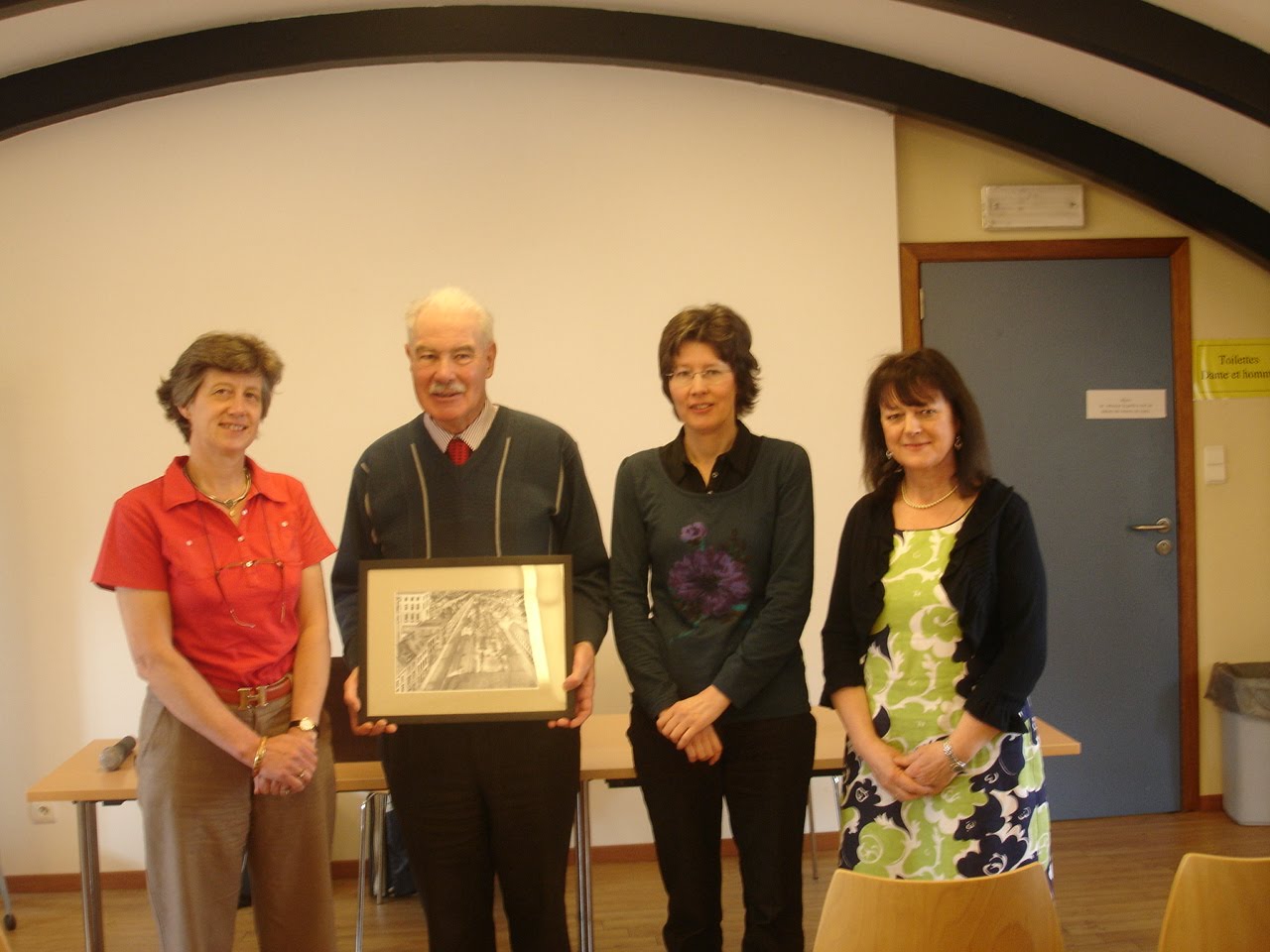
Isabelle Peere (our host at the university), Angus Easson, Helen MacEwan and Sally McDonald, Chair of the Brontë Society Membership Committee
We then had a break for lunch at the Comic Strip Museum restaurant.


Members having lunch in the Strip Cartoon Museum
In the afternoon we welcomed our next speaker, Dr Sandro Jung of Ghent University. This was a change in the schedule, for originally a meeting with author Jude Morgan was planned; he had to cancel and Dr Jung was luckily able to step into the breach only a few days before our weekend. Thank goodness! And we couldn’t have been more fortunate, for his lecture about Villette tied in well with Prof. Easson’s address that morning.

Sandro Jung with Helen MacEwan
His lecture, Curiosity in Villette, explored the theme of curiosity, observation, investigation and gaze in Charlotte’s novel. In his argument these ‘detective’ forms are used to project the different emotional perspectives of the main female characters in the novel. He explained that each character used this as an instrument for understanding (or even using) the world around them, all on a different kind of level.


Marina Saegerman hands Sandro Jung one of her Brontë poems worked in calligraphy
Unfortunately, as we came to the end of our afternoon, there wasn’t that much time left to get an audience feed-back, but all the interesting views and points left us with more than enough to think about. I find that no matter how often you hear new points of views in lectures you might either agree or disagree with, you’re always left with some new insight which enhances your understanding of the novel(s).

Sandro Jung after his talk
Thanks to these wonderful two speakers, this eventful and mind-boggling day will no doubt have a lasting impact on many of us; I certainly wouldn’t have wanted to miss them.
Last, but not least, we also paid special thanks to Isabelle Peere for all her efforts in making this weekend possible.

Isabelle Peere gets a present
Our two speakers kindly agreed to join a few of us when we agreed to go to the Grand Place for a well-deserved drink. As we stepped outside the university building, it appeared Brussels was bathing in warm sunshine when we walked towards the centre of the old town, meeting large crowds of tourists and shoppers that busy Saturday afternoon along the way.
A nice coincidence happened; when we were sitting in one of the old cafés in the Grand Place, we heard instruments playing outside and two giant puppets (called Jan and Jannika?) appeared. An authentic, old Brussels folkloric scene took place. This was a scene from Prof. Easson’s talk that morning when he mentioned Mrs Gaskell’s sharp observation of old Brussels history and which she later wrote in her biography.
After some farewells and goodbyes it was off to the Rue Teracken, as I always feel obliged to simply walk in that old, original street during each visit to Brussels, and say hello to the old quarter of which so little remains. I was also curious to see if the plaque at the end of that street was still up. It was…luckily! But oh dear, the street itself had lost its original stone paving. To my sadness I would no longer be able to touch and feel the old cobbles which I believed Charlotte and Emily might once have walked on. It was, I saw, paved with new cobbles and grey strips of hard stone. From the few places and streets still remaining and which belonged to the old Isabelle quarter, even the Rue Terarcken had not been spared the consequences of a make-over.
On our last day, Sunday 25th, a guided walk around Brontë places was led by Myriam Campinaire in the morning. I personally didn’t go on that, as I’ve been before, but for those who went and hadn’t been familiar with the old streets, it certainly was an eye-opener. Around noon we all met up for lunch on the roof terrace restaurant of the Museum of Musical Instruments with its fabulous views of Brussels, where we enjoyed some good food, a glass of beer or wine, and more enjoyable conversations.

Lunch in the Musical Instruments Museum restaurant
For those interested we crossed over the square to the quieter garden of the Belle Vue, where we continued our conversations and discussions in what was a well-attended meeting, chaired by Helen. Now we have become a considerably bigger group in a short space of time, it was a good idea to take stock and discuss what ideas we had for the future. There is a lot of work involved in organising events, so it was nice to get a positive feedback from those willing to offer their help.
Sadly, at the end of our meeting it was time go home and say our farewells to members and friends. It was time to take my train back to the Netherlands. I must say, I had a wonderful weekend to look back on, my curiosity rewarded, my energies replenished and lovely people I spoke to.
I will hopefully see many again in a month’s time or so, when we will have the chance to meet in Haworth, during the Brontë Society’s AGM.
See you there perhaps?!
Selina Busch
Thursday, 29 April 2010
Interview with Helen MacEwan by the European Commission magazine
The weekly staff newspaper of the European Commission (where I work as a translator) did an interview with me about the Brussels Brontë Group. Many members of the group work at the EU institutions in Brussels. The newspaper has a circulation of around 50,000.
Helen MacEwan, an English translator in DGT, talks to Commission en direct about the Brontë sisters’ connection with Brussels and the society she set up to celebrate one of the world’s most fascinating literary families.

How did the Brussels branch of the Brontë Society start?
Soon after moving to Brussels, I re-read Charlotte Brontë’s Villette and became fascinated by her two-year stay in Brussels, on which the novel is based. I started to read more about her Brussels years and the places associated with her stay here. I was already a member of the UK Brontë Society and it seemed logical to start up a branch here because of the importance of Brussels in Charlotte Brontë’s writing. The Society has members worldwide and there were already some in Belgium but no events or meetings had ever been organised here. The group has grown from a small core of about eight people who met in my sitting-room in 2006, to around 150 on our mailing list today. Our events are open to everyone, not just Brontë Society members.
What is the connection between the Brontë sisters and Brussels?
The two eldest of the three sisters, Charlotte (then 25) and Emily (23) came to Brussels in 1842 to study. The family was not well off and they had been employed as governesses but hated the work and wanted to start their own school. They needed to improve their French in order to teach it. They stayed at the Pensionnat Heger, a girl’s boarding school near Place Royale, where they taught English, as well as learning French and also German.
How much of an influence did their time in Brussels have on their work?
On Emily’s work, probably not much, although in Brussels she read some German romantic literature which may have influenced her novel Wuthering Heights. That she was motivated enough to come here at all is amazing, since she rarely left Yorkshire and was always homesick away from the family home on the moors.
But on Charlotte the influence of her time in Brussels was huge. Two of her four novels, The Professor and Villette, are based on her time here, and in Villette she portrays the man she fell in love with, her teacher Monsieur Heger. Villette is about the experience of being an expat in Brussels and when you read the novel after living here it seems much more vivid.
Why do you think that Wuthering Heights has had such an enormous influence on all aspects of culture and continues to be reinterpreted time and time again?
As well as being endlessly analysed by learned critics, it has, of course, great popular appeal and there have been countless films and other adaptations. It fascinates each generation anew. Like Romeo and Juliet, it is a love story, a tragic one with no conventional happy ending – Heathcliff and Cathy are never united in life, since she marries someone else and then dies young. It is, in fact, a very odd novel, far removed from a conventional romantic love story. Cathy dies halfway through, and for the second half Heathcliff is obsessed by the idea of being united to her after death. It fires people’s imaginations because the passions are so intense, Emily Brontë is such a dramatic and poetical story-teller, Heathcliff has become everyone’s idea of the romantic Byronic hero, and the wild moorland setting and supernatural elements make the story so haunting. The hero and heroine are larger than life, like characters in an epic, a myth or a Greek tragedy.
Do you think the Brontë sisters were ahead of their time?
Their works were certainly different from other novels of the time, and shocked contemporary readers by their outspokenness. In fact, in some ways they had more affinity with the earlier Romantic period of Byron than with the more prudish Victorian literature of their own time. In a sense, they were timeless, not defined by any period. But Charlotte was ahead of her time in depicting feisty single women like Jane Eyre who worked for a living rather than the idealised and more submissive heroines of conventional Victorian novels. The youngest of the three sisters, Anne, was also ahead of her time in writing frankly about the trials of a woman in an abusive marriage in The Tenant of Wildfell Hall, going into details which were thought scandalous at the time.
In your reading group, do you read other authors too?
Yes, we read 19th century literature in general. Jane Austen is always hugely popular and we also read the other main novelists of the period – Dickens, Thomas Hardy, etc.
What kind of events do you organise?
Apart from the reading group, one of our most popular activities is our regular guided walks around places in Brussels associated with the Brontës’ stay. There is a lot to see and talk about even though the school where they stayed was demolished and the site is now occupied by the Palais des Beaux-Arts.
We also hold regular talks on all aspects of the Brontës. Once a year, we organise a Brontë weekend. In the past, we have had audiences of up to 80 people. The group is multinational and I have been pleasantly surprised by the tremendous interest in the Brontë sisters among people of all nationalities. Many of them were previously unaware of the Brontës’ Brussels connection.
Aside from your passion for literature, what other things interest you?
My other great love is history and one reason I enjoy reading the literature of previous centuries is that it is the best way of getting the feel of a period.
Where are you from, and what has your career path been until now?
I’m British. I studied French and Spanish at university and then took a post-graduate teaching qualification. After some years teaching English as a foreign language in Spain, I moved into translation, also in Spain, working as a company translator at Deloitte, among other firms, before coming to Brussels in 2004.
Interview by Emily Macintosh
Helen MacEwan, an English translator in DGT, talks to Commission en direct about the Brontë sisters’ connection with Brussels and the society she set up to celebrate one of the world’s most fascinating literary families.
How did the Brussels branch of the Brontë Society start?
Soon after moving to Brussels, I re-read Charlotte Brontë’s Villette and became fascinated by her two-year stay in Brussels, on which the novel is based. I started to read more about her Brussels years and the places associated with her stay here. I was already a member of the UK Brontë Society and it seemed logical to start up a branch here because of the importance of Brussels in Charlotte Brontë’s writing. The Society has members worldwide and there were already some in Belgium but no events or meetings had ever been organised here. The group has grown from a small core of about eight people who met in my sitting-room in 2006, to around 150 on our mailing list today. Our events are open to everyone, not just Brontë Society members.
What is the connection between the Brontë sisters and Brussels?
The two eldest of the three sisters, Charlotte (then 25) and Emily (23) came to Brussels in 1842 to study. The family was not well off and they had been employed as governesses but hated the work and wanted to start their own school. They needed to improve their French in order to teach it. They stayed at the Pensionnat Heger, a girl’s boarding school near Place Royale, where they taught English, as well as learning French and also German.
How much of an influence did their time in Brussels have on their work?
On Emily’s work, probably not much, although in Brussels she read some German romantic literature which may have influenced her novel Wuthering Heights. That she was motivated enough to come here at all is amazing, since she rarely left Yorkshire and was always homesick away from the family home on the moors.
But on Charlotte the influence of her time in Brussels was huge. Two of her four novels, The Professor and Villette, are based on her time here, and in Villette she portrays the man she fell in love with, her teacher Monsieur Heger. Villette is about the experience of being an expat in Brussels and when you read the novel after living here it seems much more vivid.
Why do you think that Wuthering Heights has had such an enormous influence on all aspects of culture and continues to be reinterpreted time and time again?
As well as being endlessly analysed by learned critics, it has, of course, great popular appeal and there have been countless films and other adaptations. It fascinates each generation anew. Like Romeo and Juliet, it is a love story, a tragic one with no conventional happy ending – Heathcliff and Cathy are never united in life, since she marries someone else and then dies young. It is, in fact, a very odd novel, far removed from a conventional romantic love story. Cathy dies halfway through, and for the second half Heathcliff is obsessed by the idea of being united to her after death. It fires people’s imaginations because the passions are so intense, Emily Brontë is such a dramatic and poetical story-teller, Heathcliff has become everyone’s idea of the romantic Byronic hero, and the wild moorland setting and supernatural elements make the story so haunting. The hero and heroine are larger than life, like characters in an epic, a myth or a Greek tragedy.
Do you think the Brontë sisters were ahead of their time?
Their works were certainly different from other novels of the time, and shocked contemporary readers by their outspokenness. In fact, in some ways they had more affinity with the earlier Romantic period of Byron than with the more prudish Victorian literature of their own time. In a sense, they were timeless, not defined by any period. But Charlotte was ahead of her time in depicting feisty single women like Jane Eyre who worked for a living rather than the idealised and more submissive heroines of conventional Victorian novels. The youngest of the three sisters, Anne, was also ahead of her time in writing frankly about the trials of a woman in an abusive marriage in The Tenant of Wildfell Hall, going into details which were thought scandalous at the time.
In your reading group, do you read other authors too?
Yes, we read 19th century literature in general. Jane Austen is always hugely popular and we also read the other main novelists of the period – Dickens, Thomas Hardy, etc.
What kind of events do you organise?
Apart from the reading group, one of our most popular activities is our regular guided walks around places in Brussels associated with the Brontës’ stay. There is a lot to see and talk about even though the school where they stayed was demolished and the site is now occupied by the Palais des Beaux-Arts.
We also hold regular talks on all aspects of the Brontës. Once a year, we organise a Brontë weekend. In the past, we have had audiences of up to 80 people. The group is multinational and I have been pleasantly surprised by the tremendous interest in the Brontë sisters among people of all nationalities. Many of them were previously unaware of the Brontës’ Brussels connection.
Aside from your passion for literature, what other things interest you?
My other great love is history and one reason I enjoy reading the literature of previous centuries is that it is the best way of getting the feel of a period.
Where are you from, and what has your career path been until now?
I’m British. I studied French and Spanish at university and then took a post-graduate teaching qualification. After some years teaching English as a foreign language in Spain, I moved into translation, also in Spain, working as a company translator at Deloitte, among other firms, before coming to Brussels in 2004.
Interview by Emily Macintosh
Saturday, 13 March 2010
Brontës on Belgian stamps


The Belgian post office has issued an attractive set of stamps on the subject of "a literary walk through Brussels" with pictures of famous 19th century writers who stayed in the city. They are Victor Hugo, Charles Baudelaire, Paul Verlaine, Arthur Rimbaud, the Dutch writer Eduard Douwes Dekker and - Charlotte and Emily Brontë!
The Brontës are in somewhat incongruous company, since their stay in Brussels studying French at a girls' boarding school (in 1842-43) could not have been more different from the colourful and often squalid existence of the French writers who accompany them on this set of stamps.
Victor Hugo came to Brussels with his family and his mistress, who lodged nearby, as a political refugee, fleeing Paris after Napoleon III's coup d'état. Baudelaire, author of the volume of poetry Les Fleurs du Mal which had caused a scandal, came to Belgium to escape from his creditors. Verlaine and Rimbaud were reunited in Brussels after one of the many rifts in their stormy relationship but were soon quarrelling again. After a row, Verlaine shot and slightly wounded Rimbaud, who reported him to the police. As a result, Verlaine was sentenced to two years' imprisonment.
The Dutch writer in the set, Dekker, who wrote under the alias of "Multatuli" (Latin "I have suffered much"), was also a controversial figure because of his novel Max Havelaar, an indictment of Dutch colonial rule based on his own experience in the Dutch East Indies, which he wrote in Brussels.
Of all these writers, Charlotte Brontë was the only one who drew significantly on her Brussels experience in her writings.
These beautiful stamps were designed by Jan De Maesschalck and cost €5.90.
Helen MacEwan
Sunday, 28 February 2010
Breaking the Brontë Mould

In the photo, Nicholas Marsh in Brussels with Isabelle Peere (lecturer at Facultés Universitaires Saint-Louis which hosted his talk), Helen MacEwan and students of the university and of the British School of Brussels
On Saturday 27 February Nicholas Marsh, who is editor of Palgrave Macmillan's Analysing Texts series and has written books for the series on authors ranging from Shakespeare and Jane Austen to Virginia Woolf, came to Brussels to analyse Wuthering Heights, one of the works he has written on. He talked about its narrative frame, one of the most fascinating aspects explored in his book on the novel.
Mr Marsh has taught in further education and secondary schools and the series, which was conceived by him, is intended first and foremost for students and is based on examination of key passages in the texts in question. He is also the author of the popular How to Begin Studying English Literature.
Our members turned out in force and we were joined by a large contingent of students of Facultés Universitaires Saint-Louis which hosts our events, and a group of sixth-formers from the British School of Brussels with their teachers.
Because of the disruption of the Brussels-Paris Thalys train service, Nicholas Marsh had driven from Paris, where he lives, to be with us at 11 a.m. We're very grateful to him for accepting our invitation to talk to us and for getting up early to do so! His talk was much enjoyed for he speaks as lucidly and interestingly as he writes.
After dispersing for lunch on this surprisingly pleasant sunny day given the terrible weather we've been enduring for so long, we returned to watch a documentary film on the Brontë family. Both talk and film provoked plenty of discussion.
Emily Waterfield was there and has written this report on the day:
Two events hosted by the Brussels Brontë Group on 27 February aimed in their different ways to shake up received notions about the Brontës. A biographical film gave a clear introduction to the family, from Patrick’s marriage to Maria Branwell in 1812, through the lives and deaths of his wife and six children. It steered clear of many myths and much of the romance that have grown up around the Brontë family, looking instead at the everyday and the factual. Notably, the film focused on the many houses and interiors the sisters would have known and which feature in all their works, rather than on the Yorkshire moors so famously associated with them.
The scholar Nicholas Marsh meanwhile gave a presentation on the multi-layered and often problematic structure of Wuthering Heights. Author of the ‘Analysing Texts’ study of Wuthering Heights, Mr Marsh argued that by examining its language and voices we can appreciate far more of it than through a simple understanding of the story’s events.
By analysing selective passages narrated by Lockwood and Nelly Dean, he suggested that Emily was deliberately “breaking the frame” by adopting a subversive narrative structure.
One way of understanding this would, he said, be in terms of the Marxist critic Terry Eagleton’s theory of ‘possible consciousness’, whereby no-one is capable of expressing more than the understanding imposed by the period in which they live – and furthermore according to which any effort to go beyond this leads to a breakdown of language. Seen in this light, Cathy and Heathcliff’s bond goes beyond what Emily Brontë’s time could consciously deal with.
Mr Marsh’s own way of describing the limitations imposed by the structure was to suggest seeing the main story (Cathy and Heathcliff) as a flood, and Nellie or Lockwood as a hosepipe, vainly attempting to channel the torrent.
We are made aware of this limitation from the opening pages of the book. Lockwood begins his narrative with a redundant date: 1801, apparently in an attempt to impose some factual order on the events that follow. The chapter is then dominated by vague guesswork (“Here we have the whole establishment of domestics, I suppose”) and efforts to translate the unfamiliar northern language into Lockwood’s own affected terms (“‘Wuthering’ being a significant provincial adjective, descriptive of the atmospheric tumult to which its station is exposed in story weather”.)
Nelly is also a “guesser” whose assumptions and understanding do not match the responses of the novel’s main protagonists. When Cathy lies dead, Nelly tries to comfort Heathcliff with talk of “heaven…lamb…child…her life closed in a gentle dream.” Heathcliff in response “dashed his head against the knotted trunk and…howled…like a savage beast.”
As Mr Marsh said, “There is an insistent feeling that this is being seen through a limited point of view.”
Why then impose this strange structure on passages so powerful that they still move us today?
There was of course no suggestion that Nelly or Lockwood represent Emily’s own voice, or that she would have been incapable of adopting a more empathetic persona: the striking differences between Lockwood’s educated vocabulary, Nelly’s sentimentality and Heathcliff’s monosyllables, for instance, show her to be capable of convincingly changing voice at will.
In part, the audience were told, the narrative structure echoes the limits of other “frames” in the novel: the boundaries of Thrushcross Grange, crossed by the younger Cathy despite her father’s efforts, or the frame of the elder Cathy’s coffin, broken by Heathcliff.
In part, added Mr Marsh, Nelly and Lockwood can also be seen as Emily’s critique of early Victorian attitudes.
But above all, he said, Wuthering Heights is “a book about imposing unreasonable demands”.
This attitude helps us to understand Lockwood’s strange dream in Chapter 3 of the book, when he is subjected to 490 lengthy parts of a sermon and reacts angrily to the preacher’s assumption that his brethren will listen to more. “Seventy times seven have I plucked up my hat and been about to depart – Seventy times seven have you preposterously forced me to resume my seat. The four hundred and ninety first is too much.” The riot against him provoked by his outrage suggests he should have gone along with the unreasonable “first of the 71st.”
As the dying Cathy says to Heathcliff, “If I dare you now, will you follow?”
Emily Waterfield


In the bottom photo, Nicholas Marsh with members of the Brussels Brontë Group. From left to right: Patty Simou, Maureen Peeck, Myriam Campinaire, Nicole Verhaghen, Nicholas Marsh, Helen MacEwan, Sherry Vosburgh, Marina Saegerman, Brigitte Merle, Patricia de Gray
Subscribe to:
Posts (Atom)