Home

Wednesday, 14 November 2012

Book launch of 'Down the Belliard Steps: Discovering the Brontës in Brussels’

In the previous post, we brought news about Helen MacEwan's recently published book on the story of the Brussels Brontë Group. See post of 10 november. 

There will be a special book launch in Waterstones at 18.30 on Wednesday 28 November.
Helen will tell more about the inside story of how our group came to be, the significance of the Brontës' time in Brussels, and she will introduce the people who set the group up and those who have contributed to it since then. 
Drop by if you can and get your copy then. 

The book has over 40 illustrations in colour. It is now available in Waterstones and Sterling Books in Brussels (price €17.50) and can also be ordered from the Brontë Parsonage bookshop in Haworth (price ₤13.99).

Wednesday 28 November 2012 at 18.30 at Waterstone’s bookstore, Boulevard Adolphe Max 71, 1000 Brussels

See you there!

Saturday, 10 November 2012

The Brussels Brontë Group celebrated in a book by Helen MacEwan


Helen MacEwan writes:

A project I’ve been working on for some time, a book about the genesis and development of the Brussels Brontë Group (which started up in 2006) is finally completed; it has now been printed and copies are available. You can buy it in the English bookstores Waterstones and Sterling Books in Brussels, or from the Brontë Parsonage Museum shop. Go to Brontë Shop – Books – Miscellaneous.

In the course of writing it I interviewed and spoke to many people in the group, and the book is about their discovery of the Brontës in Brussels as well as mine. So it’s something of a group project.

The book is called Down the Belliard Steps: Discovering the Brontës in Brussels


Description of the book:

Charlotte and Emily Brontë’s stay in Brussels in 1842-43 to improve their French was to prove a momentous one for Charlotte in particular. She fell in love with her French teacher, Constantin Heger, and her experiences in the Belgian capital inspired two of her four novels, Villette and The Professor. Yet the Brontës’ Brussels episode remains the least-known of their lives.

When Helen MacEwan moved to Brussels in 2004 she discovered that not many people there seemed to know much about the Brontës’ time in the city. She herself had a lot to find out about their life in the Pensionnat Heger at the bottom of the Belliard steps. In the process of doing so she met other people who were similarly fascinated by the story, and with them formed the Brussels branch of the Brontë Society.

Photo: Cassandre Sturbois

For all these people, following in Charlotte and Emily's tracks in modern-day Brussels, and setting up a literary group, was a voyage of discovery. In the course of telling their story, Helen finds some odd parallels between the Brussels of their day and ours, and reflects on why the Brontës' time there is so fascinating.

ISBN No 978-0-9573772-0-2
Paperback
146 pp

Wednesday, 31 October 2012

Brussels Brontë walk filmed for ITV documentary


Whatever the future may hold for the Brussels Brontë Group, 27 October 2012 will always stand out as a high spot in our annals. For us personally it was the day we got the opportunity to take part in a TV programme. More generally, it represented recognition of the role played by Brussels in the Brontë story.

In mid-September I was contacted by Gareth Williams of Blakeway North Productions, a TV production company in Manchester. He was to direct and produce a one-hour documentary on the Brontës, one of a series called Perspectives in which a well-known personality talks about a literary, artistic or musical passion – Andrew Lloyd-Weber on the Pre-Raphaelites, Griff Rhys Jones on The Wind in the Willows. The documentary was to be presented by the actress Sheila Hancock (Sheila is also the widow of John Thaw who played Inspector Morse in the TV detective series).

Gareth Williams explained that the film would be a voyage of discovery for Sheila Hancock as she travelled round the north of England visiting Haworth and other places important in the sisters’ lives, such as Roe Head School, while exploring their story in conversation with Brontë biographers such as Juliet Barker and Lyndall Gordon. The film crew would also head south to London where Sheila would look at the Heger letters in the British Library.

But there was also a location outside England where Gareth wanted to film. He felt that documentaries about the Brontës didn’t always place enough emphasis on the significance of their stay in Belgium. In conversation with me he learned that we organised guided walks around the Brontë places in Brussels. Could he bring Sheila Hancock to Brussels and film her following in the Brontës’ tracks here as she joined a group to listen to one of our guides?

A few weeks later Maire Tracey, the assistant producer for the programme, came to Brussels to reconnoitre. She spent some hours with guides Myriam and Jones and myself going round the walk route. It was a day of brilliant sunshine in early October. The crew were to come out the weekend before Halloween and we warned her that in late October they would be lucky indeed to have a repeat of such weather.

We checked the weather forecast anxiously every day in the week leading up to the 27th. Both the weather that week and the forecast for the weekend were dire. We had been enjoying a brief Indian summer but now temperatures plummeted. Two days before our date with Gareth Williams and his team the forecast was for thunderstorms, heavy rain and temperatures near zero. On the 26th it poured and we were afraid to check the forecast.

Saturday the 27th got off to an uncertain start but quite early in the morning the sun came out – and stayed out. It seemed too good to be true. It was, however, cold. At 1 pm a group of ten of us met the film crew of five (Gareth, Maire, cameraman, sound man and make-up girl) outside the Protestant church in a chill breeze but under a blue sky. 

The film crew (director Gareth Williams is on the right)
Sheila Hancock, tall and very elegant in her ankle-length coat and scarf, joined our group to listen to Myriam, who seemed unfazed as the camera zoomed in, the sound man held his fluffy microphone high over our heads and the make-up girl occasionally darted forward to spray Sheila’s hair or dab at her face although neither hair nor face seemed at all in need of her attention. Half-way through the walk Sheila was offered some gloves which she refused initially because they would mar ‘continuity’. When the temperature dropped a further degree or two, however, the gloves went on!

Sheila Hancock
The rest of us, with hair unattended to by the make-up girl, enjoyed ourselves despite the cold and soon got used to the presence of the camera. Occasionally there was a re-take, for example when background noise became a problem, one instance being the slamming of car doors when the guests departed after a wedding in the Protestant church. The film crew had been concerned that from the outside it didn’t look like a church, but the emergence of the wedding guests provided suitable cinematic confirmation and they asked Myriam to synchronise the start of her talk with the appearance of the bride and groom.

The group with Sheila Hancock (fifth from the right) and guide Myriam (on the right).
In Place Royale our great day could have ended in tragedy as we wandered into the centre of the square while the cameraman took shots, regardless of traffic and the fact that at one stage some of us were standing on the tramline!

Myriam started by setting the scene: what brought Charlotte and Emily here all the way from Haworth, why they chose Brussels, how they funded their study trip. At the top of the Belliard steps looking down at the site of the Pensionnat, she took us in imagination into the school and told us how M. Heger’s tuition improved the sisters’ writing style. But as she embarked on Charlotte’s relationship with her teacher, clearly a subject of great interest to Sheila, the director and the future viewers of the programme, the first hailstones fell from a cloud that had been steadily blackening overhead. The weather had turned wuthering, giving us a taste of the Yorkshire moors. We hurried down the stairs seeking shelter, feeling a little like Lucy Snowe fleeing Place Royale, and took refuge in a café opposite Bozar.

Sheila asked questions of the guide and drew the rest of the group into discussion as well. She picked up on various points that interested her, wondering for example whether Emily was as miserable in Brussels as is generally assumed; she obviously enjoyed learning German, and used to study it with a book propped up in the Parsonage kitchen while she made the pastry. Sheila also wanted to know exactly what kind of man M. Heger was, and how Charlotte’s relationship with her teacher was reflected in her novels. She also quizzed us about our take on the Brontë-Heger letters. She had seen them a few days earlier in the British Library; was it known for certain who tore them up, who sewed them together again, and above all, why?

She speculated about the Heger side of the correspondence and whether some letters are waiting to be discovered somewhere, like the manuscript of ‘L'Ingratitude’ that Brian Bracken found last year at the Musée de Mariemont. In her talk to us two weeks earlier Lyndall Gordon had also speculated about Heger's letters to Charlotte being hidden somewhere. Perhaps, like Lucy Snowe, Charlotte had buried them in a jar in the garden.
Sheila hinted at a couple of interesting discoveries made in the course of filming, including one at the British Library while viewing the letters and another at Roe Head. We’ll have to wait for enlightenment until the programme is broadcast.

The sun shining again, we walked to the cathedral. The tour which had begun in bright sunshine in front of the neo-classical building housing the Protestant church ended in sunshine before the Gothic cathedral where Charlotte, despite her anti-Catholic rants, one day persuaded a priest to listen to her confession…. of what exactly?

After we had speculated about that for a bit it was time for the crew to rush Sheila off to one of the olde worlde cafés in Grand Place where they’d arranged to film her final musings on the importance of Brussels for the Brontës. With the Hôtel de Ville as a backdrop, she summed up how crucial their time here was to their development as individuals and as artists. We too adjourned to a café, to warm ourselves with mulled wine and talk over our afternoon. We were still talking as the film team caught the Eurostar back to London.

Brussels was the last port of call for the team, and the next six weeks will be spent editing the material amassed. The date the programme will be broadcast is not yet fixed but will be early next year. We’ll watch with interest to see just how red our noses were from the cold, which moments of the tour are saved from the cutting room floor and what conclusions Sheila drew from her time with us following in the Brontës’ footsteps in Brussels.

Helen MacEwan
with contributions by Jones Hayden

Wednesday, 17 October 2012

Lyndall Gordon shows us Charlotte Brontë’s hidden face

On 13 October 2012 Dr Lyndall Gordon (St Hilda’s College, Oxford; author of several biographies including of Virginia Woolf and Emily Dickinson) gave a talk called The Hidden Face of Charlotte Brontë in which she explored some of the insights she gained in writing her biography Charlotte Brontë: A Passionate Life.

Lyndall Gordon proved to be as fascinating and engaging as a speaker as she is as a writer. She spoke of the gap between Charlotte’s inner and outer self, the different selves she presented in letters to different friends and the person we find in her journals and novels.

The Brontës resented the fact that as governesses they often seemed to be invisible, yet Charlotte herself presented a demure and ladylike exterior when it suited her – to Mrs Gaskell, for example. Drawing comparisons with other women writers of the period, Lyndall Gordon reflected on the tension and power created in her novels by this gap between her private and public persona.

Dr Gordon has a particular interest in the Brussels period and considers that it was in Brussels that Charlotte became a writer. Heger understood her as a person as well as nurturing her talent. Her fictional heroes were similarly capable of engaging with her heroines’ inner selves.

Brontë had a similar experience with her publisher George Smith. She had subtle and ‘indefinable’ relationships with both men, creating intimacy with them through letters.

Turning lastly to Arthur Bell Nicholls, Dr Gordon said that in marrying him Charlotte chose life over art and that she found happiness in her marriage.

The discussion that followed was very lively and wide-ranging. Lyndall Gordon told us that in a few days’ time she was to be filmed in the British Museum, talking about the Heger letters, for a documentary on the Brontë sisters to be shown as part of ITV’s Perspective series. The crew will then be coming to Brussels to film with our group. During the discussion we took the opportunity to explore some of the questions the documentary will be raising, such as the factors that may have contributed to producing the phenomenon of the Brontë family. We doubted that the programme would find all the answers in the hour allocated to it!

Over the weekend we enjoyed showing Lyndall and her husband around the Brontë sites and pointing out the confessional in the cathedral where, in 1843, a priest may have had a glimpse of that inner self of Charlotte Brontë we were able to explore with Lyndall Gordon.

Lyndall Gordon (fifth from right) with members of the Brussels Brontë Group.
Photo: Paul Cagli

Wednesday, 27 June 2012

Haworth, a little piece of Heaven on earth? or how a dream came true after fifty years

Top Withens


At the beginning of February 2012 I learned for the first time about the existence of the Brussels Brontë Group. Reading about the Brontë Society’s Annual General Meeting in Haworth, all at a sudden, an old and dormant dream reared its head.

It was at the end of the sixties that Heathcliff, Cathy, Nelly and Mr Lockwood came in my life and never would leave it. That time I swore an oath that one day I would go over there and see Haworth, the Parsonage, Wuthering Heights, the Brontë Waterfall, Penistone Crag and Thrushcross Grange and experience the atmosphere of the Moors in good or bad weather, in rain, sunshine or in the clouds. 

However, everybody knows how the river of life can flow in a strange riverbed before it is flowing into the sea. In my particular case, full with obstacles and it would take me fifty years before this dream came true. 

Perhaps you will find that I am exaggerating but one could compare this trip with the last five days of Sir Edmund Hilary and Tensing Norgay on their Himalaya Expedition, climbing and climbing till they reached the top of Mount Everest on May 29, 1953.

Friday 8 June 

Arrival at Haworth, my “base of operation”. The programme planned so carefully was now to be carried out. Would I, just like Hilary, reach the summit too? 

After exploring the Parsonage and Haworth I joined the Brussels members in the Old White Lion where I also made new friends and experienced for the first time that I had made a step in the direction of this small piece of Heaven on earth, or to the top of Mount Everest. The second camp was attained.

Saturday 9 June 

4.30pm: Annual General Meeting of the Brontë Society. “Society members only. Membership cards will be required.” 

With my new membership card in my hand, somewhat enjoying being, as a Belgian, a member of a British literary society, I walked into the conference room on the first floor. For a newcomer as I was, it was the people attending this meeting who drew especially my attention. Young, middle-aged, old and very old, all interested in one thing, the progress of this beautiful part of British Heritage: “The Brontë Family”, a special experience, a special feeling. 

7.00pm: Supper in “The Old White Lion” with the Brussels friends 

We kept talking and talking for hours because there was so much to tell although it was only my second day. And when for each of us the time came to go back to our B&B or hotel, I realized that not me, on my own, but all these people together, this crew, our “expedition”, had reached our third camp on the way to the summit. 

Sunday 10 June 

Breakfast time in the B&B was not simply enjoying the copious delicious meal prepared by David but at the same time taking part in the “group discussion” with other members about what else than… the Brontë Family, Charlotte, Jane Eyre, Emily, Cathy, Heathcliff and so on, the whole family “passait le revue”. Each one of the guests with his/her point of view and sometimes trying to convince the others. 

11.00am: Walk over the moors to Oxenhope 

1.00pm: Walk around historical Haworth. 

6.30pm: Informal evening of friendship, fun and food at The Old White Lion. 

Today the informal evening of friendship was officially organized by The Brontë Society but we had already had two and this one could only extend this magnificent feeling. Every evening, meeting with these friends after the daily occupations was just bringing us to a higher level of harmony, bringing us to the next camp, the camp of Hilary and Tensing before their effort to reach the top of Mount Everest. So I felt. 

These everlasting conversations about all kind of subjects, from “the Brontës” to our own families (we even drew sketches of our houses), literature, movies, music, all this meant that we realized that the moment when we would have to say good-bye would be difficult for each of us.

Monday, 11 June 

11.00 am: Tourist Information Centre – meeting point for the walk over the moors 

This day I was to realize my dream of more than 50 years, the reason why I was coming to Haworth. Sarah, my guide, was to take me and possibly a few other people to do the walk over the moors to Wuthering Heights (Top Withens), The Brontë Waterfall and Bridge, Penistone Crag (Ponden Kirk) and Thrushcross Grange (Ponden Hall) back to Haworth. The places so beautifully described by Emily Brontë in her novel “Wuthering Heights”. 

Whatever the weather should be, I wanted to do it, wanted to be another Mr Lockwood or Heathcliff and go to these places. 

And here comes again my comparison with Sir Edmund Hilary: this last and famous trip meant to me, perhaps, something similar to what it might have meant to him: the last day bringing me to the summit of my stay in Haworth, as if I was stepping into the story and experiencing a little bit what was told so well by the author two centuries ago. 

We were joined at the last moment by a young Swiss man who had read about the trip on the Haworth website. We were ready, our clothes, our boots, our packed lunches, and soon we were marching, leaving Haworth behind us, soon entering into the moors and in my mind, at the same time, going back into the nineteenth century. 

For me, unknown rough territory but I enjoyed it, especially because of the whole story behind it. The weather was what it should be: the sun was not shining but it was cloudy with low-hanging fog banks, some wind, from time to time a little bit of drizzly rain alternating with an up-clearing sky. I became a part of this “Brontë atmosphere”. 

The landscape was varying very strongly, we followed the path of the sheep, climbed to the crest of the hill, got for the first time a glance of a distant tree near Wuthering Heights, descended, and climbed and descended again to arrive at the end at Brontë Waterfall and Cathy’s chair. 

We wanted to stay longer but the way ahead was still so long and so many places had to be seen so that we continued our path, direction Brontë Bridge. Marvellous place with the splashing water in the wild nature. Some photos taken at the spot should help to keep it saved in our brain. 

And again we continued our path, sometimes talking, sometimes in silence listening to the splashing water of the brook, a bird in the sky, the bleating of a faraway sheep or just to the wind in our ears, climbing out of the valley towards another crest of the hill, passing through the haze to find out that this distant tree ahead, finally, is close by and we are only some hundreds of metres away from “Wuthering Heights” (Top Withens). 

I feel my heart beating faster coming closer to this place I have dreamed about so many years and now it is here. An unforgettable moment. I look around and see the panorama and understand very well what the memorial stone in the wall is telling me: 

“This farmhouse has been associated with "Wuthering Heights", the Earnshaw home in Emily Brontë's novel. The buildings, even when complete, bore no resemblance to the house she described, but the situation may have been in her mind when she wrote of the moorland setting of the Heights”. 

The building in itself may be unimportant, but not so the location. 
We took the time to have our lunch in this sacred place so that we could stay a little bit longer, experience the atmosphere, feel nature, join Emily’s characters and of course take some pictures to preserve this place for posterity.


Had I now reached the summit? Yes and no, because Penistone Crag (Ponden Kirk) and Thrushcross Grange (Ponden Hall) belong as well to these places that had to be seen. 

And so we continued our walk to Penistone Crag. 
In reality a grit stone outcrop, a nature reserve but for Brontë fanatics a place where the two young people in love, Heathcliff and Cathy and later Hareton and Cathy’s daughter, met each other to find some happiness. 

What a feeling, how wonderful to stand there on top of this rock in the idea that Emily Brontë one day must have stood there admiring the beautiful landscape. 

Only Thrushcross Grange (Ponden Hall) remains to be seen, the contrast with Wuthering Heights, the contrast between a humble farm and a manor. 

The path to Ponden Hall is much easier as we are descending to the valley, more houses and farms appear and the landscape shows more signs of people’s activities. After a while we pass some outhouses and a little later an impressive house with a stately entrance, many windows and surrounded by a garden and a high imposing wall. At the other side of the road another garden, also surrounded by a similar imposing wall. Ponden Hall. 

Sarah, our guide, tells us: “This is Thrushcross Grange in the novel”. 

What a difference with “Wuthering Heights”, a difference that makes one better see all the consequences and influences on the lives of the characters. Now, after all these years, having been there, I better understand this wonderful novel. 

The task was fulfilled, the summit was reached. 

With some luck we would have had a guided tour of the house by the owner but the lady of the house had to leave. The window in the bedroom where Cathy begs: “Let me in, let me in” I did not see, perhaps this is for another time. 

Slowly we took the way to Stanbury which further on would lead us back to Haworth. 

An intense feeling of contentment came over me because the dream of more than fifty years had come true. Sir Edmund Hilary had reached the summit of Mount Everest, I had been in the places I dreamed of and that was for me the summit. 

It took us seven hours but these seven hours gave me such a strong wonderful feeling, put me in such a pleased mood that I wanted to share it with all my friends. 

8.00 pm Farewell supper in The Old White Lion

For me and for a lot of our friends this supper was indeed the last one before our return journey back home.
The Old White Lion was filled up with a magnificent ambience of joy, understanding, kindness for each other. The room was filled with sparkling conversations alternating with laughter from different sides. 


But as the clock was ticking and the time of farewell came closer, here and there in a hurry addresses and e-mail addresses were exchanged because one thing was sure: I had made a lot of friends and wanted to stay in contact with them. And when then the ultimate moment was there and we really had to say good-bye I felt pain in my heart because such a spirit, such an enveloping warmth between so many people, I never had experienced. 
It was here that a new, another dream was born, the dream to come back, perhaps next year, perhaps one day if I should get the opportunity.
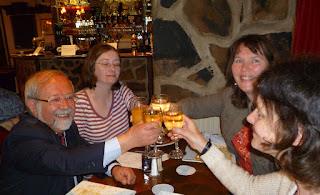

Celebrating with Brontë friends
Tuesday, 12 June 

8.00 am: Enjoy for the last time David’s English Breakfast, arrange the last formalities, pick up my luggage and take a glance at my room, appropriately called the “Charlotte” room. 

Good-bye to David and, on my way to The Old White Lion from where I was to leave by taxi for Keighley, a last look at my B&B. 

Good-bye to Haworth, Keighley, Leeds, London and back to Belgium. 

My body was in the train but my mind and my heart remained in Haworth. 

In the evening I came home, happy to be back with my family but with a heart that brimmed over with enthusiasm about my adventure in the neighbourhood of the Brontë Family and I realized, indeed, Haworth is a little piece of Heaven on earth.

Jean De Wolf