Home

Monday, 2 November 2015

Launch of ‘Charlotte Brontë’s Secret Love’, the English translation of Jolien Janzing’s novel ‘De Meester’

On 29 October members of the Brussels Brontë Group were among those who gathered at Waterstones for the launch of Charlotte Brontë’s Secret Love, the English translation of Jolien Janzing’s novel inspired by Charlotte Brontë’s time at the Pensionnat, first published as De Meester.

The Brussels Brontë Blog
On the left, Jolien Janzing
Jolien Janzing, a Dutch journalist and novelist, has lived in Flanders since early childhood. De Meester, first published in 2013 and translated into English by the prize-winning translator Paul Vincent, is her second novel. It is also to be translated into German, French and Turkish. It was selected for Books at Berlinale and the film rights have been sold to David P. Kelly films.


Earlier in October Jolien was invited by the Brontë Society to be their speaker at the Society’s annual literary lunch, held this year in Yorkshire. And on the morning of the Waterstones launch she was in London where she joined Claire Harman, author of the new biography of Charlotte Brontë just out, to speak on Woman’s Hour on BBC Radio 4 (http://www.bbc.co.uk/programmes/b06kggh1). They began by discussing Charlotte’s love for Constantin Heger and confession at the Cathedral of St Gudule. The first chapter of Janzing’s novel relates this scene in the Cathedral, and, interestingly, so does the prologue to Harman’s biography.

The Brussels Brontë Blog
Jolien reading from
'Charlotte Brontë's Secret Love
At the Waterstones launch, against a backdrop of projected images of nineteenth-century Brussels, the audience listened to readings from the novel and an interview with Jolien conducted by Jones Hayden of the Brussels Brontë Group. We heard about the novel’s vision of Charlotte and Emily’s stay at the Pensionnat, with suggestions of homo-eroticism in Emily’s friendship with a fellow pupil, Louise de Bassompierre, and more than suggestions of eroticism in Charlotte’s relationship with Monsieur Heger, the husband of the school’s directress. Rather than presenting Charlotte’s love for Heger as unrequited, Jolien explores a more romantic scenario in which Heger, portrayed as a flirtatious character, is attracted to Charlotte in his turn. She shared with us her view of 1840s Brussels (described in her novel as ‘dissolute’ and evoked with great sensuousness) as a place of relaxed morals where flirtation and adultery were very much in the air. We heard about one of the novel’s sub-plots, the liaison between King Leopold I and his much younger mistress Arcadie Claret, whose destiny is counterpointed in the novel with Charlotte’s. When the liaison began, around the time of the Brontës’ arrival on the Continent, Arcadie was only sixteen.

The Brussels Brontë Blog
On the right, Jones Hayden, who interviewed Jolien
After this presentation of a book which, unusually, offers a take on the Brontës’ stay in Brussels by a writer on this side of the Channel, attendees mingled and relaxed in the approved continental style – over a glass of wine!

Helen MacEwan

Monday, 26 October 2015

‘A contemporary novelist reads Jane Eyre’: Tessa Hadley’s talk to the Brussels Brontë Group on 17 October 2015

“No one,” they say, “can do the  impossible” – or, as Charlotte Brontë herself might have put it, following her time in Belgium, “a l'impossible, nul est tenu” - but Tessa Hadley, acclaimed novelist and lecturer in creative writing at Bath Spa University, achieved just that last Saturday afternoon in Brussels.  Faced with the challenge of finding something new and original to say about Charlotte Brontë's Jane Eyre, she captivated an audience of Brontë enthusiasts with her thoughtful comments and engaging delivery.

She began by observing that in the 1840s when Charlotte was writing Jane Eyre, the novel was still a relatively new literary form – hence the name – and contrasted its then “novelty” to its well established status today. For Brontë, Tessa suggested, was like Good King Wenceslas setting out to leave her mark upon virgin snow. Less than 200 years later, the deep and crisp and even snow has been trampled all over with foot-prints and tracks leading in all directions and no fresh fields in sight. Tessa suggested that, for writers today, this feeling of everything having been done before can be an obstacle,  but can also provide a sense of support and resource from which to borrow.

Tessa Hadley meets members of the Brussels Brontë Group 
over a drink after her talk. From left to right, 
Marcia Zaaijer, Tessa Hadley, Jones Hayden.
The talk focussed on two close readings of scenes from Jane Eyre. The first sentence “There was no possibility of taking a walk that day” - now one of the best known openings in English fiction - plunges the reader straight into the narrative with no introduction or explanations. With Jane, we see no chance of setting foot outside for fresh air and exercise. The emphatic “no possibility” creates in the reader a sense of restriction and oppression. The common use today of the technique of starting in medias res, does not prevent us from recognising its novelty in the hand of Charlotte Brontë. By the end of the first page of the novel, we understand that Jane is set apart from the warmth of the fire where Mrs Reed is surrounded by her three children and we hear her challenging  question;  “What does Bessie say I have done?” We too wonder what could a child have possibly done to deserve such treatment? The sense of injustice is palpable and this opening scene puts the major opposing forces in the novel into play: unfair repression “No” versus Jane's fight against it, or as Tessa put it, “Jane's 'Yes'! – 'yes' to life and her 'yes' to Mr Rochester”.

The second scene sees Jane locked in darkness in the red room, in which her Uncle has recently died. She screams out in terror only to be met with yet harsher treatment until she passes out completely. The scene graphically illustrates Mrs Reed's horrific inhumanity. Jane's sense of right and wrong is truer than that of the adults who surround her and understanding this, they punish her all the more. Tessa commented that whereas Charlotte Brontë could build her novel around this theme of arbitrary injustice, writers today could only treat the same subject with more nuance and irony. She noted, however, that the long tradition of novels in English literature allows modern authors to have confidence that their readers will understand them.

When we read Jane Eyre today, and irrespective of how many times we re-read it, we instinctively feel its freshness and immediacy. Feelings and passion such as Jane's had never before been expressed in fiction.  We find ourselves at the origin of the novel, something so well known to us that it is almost mythic. 2016 will be the 200th anniversary of Charlotte Brontë's birth, and although we understand only too well that her life and experience were so different from our own, Tessa demonstrated that the vital force of Charlotte's story-telling, her vision and her truth, transport modern readers, just as all the readers before them, to the moral centre of her wonderful novel, Jane Eyre.

Dawn Robey

Jane Eyre and the Harry Potter generation

This piece was written by Justine Gauthier, a student at the Université Saint-Louis in Brussels where the Brussels Brontë Group hold their talks. Her year is studying Jane Eyre and she and her fellow-students joined members of our group to hear our speaker Tessa Hadley’s talk on Jane Eyre on 17 October.

Every generation shares its own references, favourite books, heroes and heroines. The current young adult generation grew up with the Harry Potter saga by J.K. Rowling. The heroes −Harry Potter, Hermione Granger and Ronald Weasley −are all part of our reader’s imagination.  While reading Jane Eyre, I was struck by the many resemblances I could find between the two best-selling works, the saga and the novel. These led me to reflect that what touches us in a good novel doesn’t alter so much with time; we all love mystery, adventure, heroes in search of themselves and romance.


I indeed find something of Jane Eyre in the three characters mentioned.  Harry Potter, for instance, is an orphan raised in the family of his horrible aunt, his uncle and their spoilt son, Dudley. He is mistreated, considered inferior and becomes his cousin's whipping boy. Still, he knows he is different, and in a sense, superior to them. When turning eleven, he receives a letter telling him he is a wizard and is bound to go to Hogwart's witchcraft school. That is where he grows up, makes friends, discovers the secrets of the castle and fights evil.

Although Hermione Granger is a plain girl, she has a fiery intellect and always stands up for her friends and those in need of protection. Some of her fellow-students consider her inferior and call her a mudblood because she was not born in a wizards' family. Their prejudice against her is based on social class; while she does not belong to their group due to her non-magical origin, she still surpasses them all thanks to her intelligence and humane qualities, also as a witch.

Ronald Weasley is not intelligent, handsome, or particularly courageous. Yet he has a great sense of friendship and of family. Because of this he has to face up to many of his fears, which in the end makes him a real war hero as well as Hermione's loving husband.

The plot, in Jane Eyre as in Harry Potter, follows their heroine's and hero's development from their unhappy childhood to their happy marriage and parenthood throughout  a succession of tests, sacrifices and losses.

Even the settings of both works share something in common: under the external appearances of respectable family homes, Gateshead for Jane as Privet Drive for Harry are places of torment. Thornfield as well as Hogwart, where they find each a real home, have their hidden secrets, and are finally destroyed, the one by a mad woman and the other by a mad wizard and his followers.
What appeals to us in both works, I feel, is their combination of very ordinary characters whom we easily identify with, with a great and eventful plot. We sympathize with these poor and abused children, support them in their revolt, feel excited when a hopeful change comes their way, and share their concern in front of omens of danger or loss. We cannot but respond to both narratives' evocation of the deepest dimensions of life, to supernatural mystery as to true love romance.

We are looking for heroes who in their own, modest and honest way find their way out of difficult circumstances, and who – though lacking favour, power and support, come out victorious thanks to their inner force of character, courage and intelligence.

The narratives of Jane Eyre and Harry Potter are demonstrations that hard work, courage, honesty, friendship and love can overcome every obstacle. These are inspiring role models and wouldn't that be what we seek in or expect from literature?  No impossible ideals of beauty and accomplishment, but examples of ordinary yet heroic characters in their patient and enduring progress to happiness.
Justine Gauthier

Wednesday, 14 October 2015

Back on the Brontë trail in Ireland!

The 2015 annual holiday was spent as usual in our  beloved holiday spot:  Ireland. Of course, being an Ireland fanatic and a Brontë fan, it is no wonder that especially the “ Irish connection” of the Brontë story is an attraction to me.

After having visited Banagher in 2013 (where Arthur Bell Nicholls grew up and spent the last years of his life) and the Northern Irish homeland in 2014 (Rev. Patrick Brontë’s roots), we were once more on the Brontë trail, this time in the Connemara.

Ever since I read the books on the life of Arthur Bell Nicholls two years ago, I have become fascinated by this man who played such a significant role in Charlotte Brontë’s life. Over the years, without even realizing it, my husband and I visited the places in Ireland related to the Brontës, in particular the places Charlotte and Arthur visited on their honeymoon.

When reading the story about Arthur Bell Nicholls’ life I discovered where he came from and where he spent his life after returning to Ireland. I came across a few other places that needed further investigation. One of them was Kill House near Clifden in the Connemara. This is the house where Arthur’s cousin, Harriette Bell lived with her husband and six of their seven children. Harriette was
the cousin Arthur proposed to in 1851 and who declined his proposal.

My husband and I became intrigued with this house. We had been looking at the internet and found a vague location near the Sky road (Clifden). We knew the area quite well and have been driving around on the Sky road peninsula many times, but we could not figure out where the house would be situated.

This year, armed with a google map (very vague) and an old picture of the house, we went back to the Sky Road peninsula to have a better look. We were driving very slowly so as to have a good look at all the “big” houses we passed . We took all possible byways and turned corners on very narrow roads. Driving a van on those narrow Irish roads is not an easy thing to do, believe me!

Friday, 24 July 2015

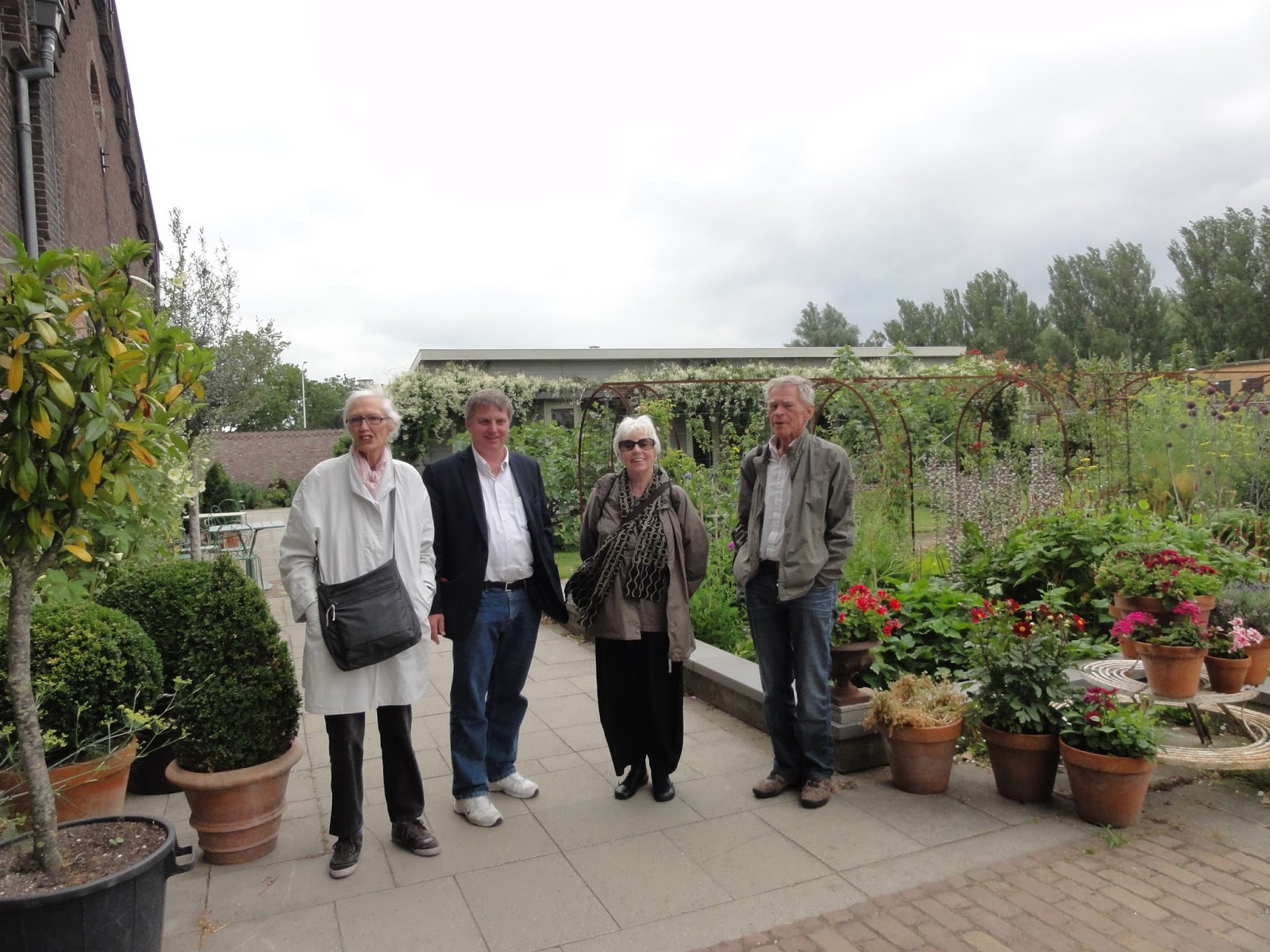
Dutch branch of the Brussels Brontë Group meeting in Dordrecht

On Sunday July 12th 2015 the Dutch branch of the Brussels Brontë Group had a meeting in Dordrecht, in the seventeenth century one of the most important cities of the fledgling Dutch Republic of the United Netherlands, and still a fine place to visit when you are interested in art and history.


We Dutch Brontë-fans are a small branch, but most of us have been life-members of the Brontë Society for years and years, so you can say we are die-hards. We spent part of our meeting in Villa Augustus remembering nice trips and good talks on the Brontës.  Jones Hayden, who had joined us from the Brussels Brontë Group, could pick up some history here.

Villa Augustus is a restaurant, hotel and garden  at the site and in the buildings of the former water-purification-plant of Dordrecht and most of the surrounding province. Don’t worry, drinking water is still purified in Holland, but on another site with more modern equipment.


The rest of the afternoon was spent in the Dordrecht Museum at the exhibition ‘Holland op z’n mooist’ (Holland at its best). There were paintings of Dutch painters like Jozef Israëls and Willem Roelofs, and later Weissenbruch,  who were influenced by the Romantic period, specially by the School of Barbizon in France.  They were very modern in painting outside, not in studios. I like to think that the Brontë’s would have enjoyed that.

Well. we did enjoy our meeting and hope the ones that couldn’t make it this time will join in next time.

Marcia Zaaijer