Home

Friday, 21 June 2013

Brontë Society AGM weekend in Haworth 8-9 June 2013

This year around 12 members of the Brussels Brontë Group headed for Haworth for the annual Brontë Society AGM weekend. Visitors to Haworth are not always in danger of getting sunburned on the moors, but this year the weather was so kind to us we needed our sun hats. Many of us joined an organised walk to Top Withens, the ruined farmhouse high on the moors thought to have inspired the location of Wuthering Heights, led by local historian Steve Wood, who also gave a talk on the history of the spot over the weekend.
One of the fixtures of the weekend is of course the Annual General Meeting itself, which gives an insight into how the Brontë Parsonage Museum is run. The Bronte Society, which currently has around 1500 members, is one of the oldest literary societies in the world (in the UK there are societies in honour of practically every well-known writer). It was set up in 1893 and has run the Museum since the Parsonage was gifted to it in 1928. The governing board, or trustees, of the Society (‘Council’) is elected by members and delegates the day-to-day running of the Museum to a Director and other staff. As well as maintaining and acquiring manuscripts and artefacts, and books for its library, the Museum is a vibrant creative centre with a very full educational and arts programme (talks by writers, art exhibitions, activities for schoolchildren).
The AGM always includes a presentation on developments during the year at the Museum which this year was given by its new Director, Ann Sumner. The TV Brontë documentary broadcast in March, in which our Brussels members took part, was seen by over 10 million viewers and has brought many new visitors to the Museum. The main excitement in the past year was the complete redecoration of the Parsonage with bespoke wallpapers and curtain fabrics, based on analysis of evidence such as scraps of wallpaper surviving from the period. Some rooms reflect the look of the house when all four siblings were alive, others Charlotte’s improvements and ‘gentrification’ when she became wealthier in the 1850s. On Sunday morning we were able to inspect the new look at a special early opening for members only.
A new acquisition was on view that is of particular interest for Brussels members: a devoir, French essay, of Charlotte’s that fell out of a book in a private collection last year – apparently the owner had no idea it was there. Members contributed £3000 towards this purchase.
Called L’Amour Filial, it was written in August 1842 and includes a few corrections by M. Heger. How many other undiscovered Belgian essays of the Brontës are out there? Could there be one in an old volume on your bookshelves or perhaps in an antiquarian bookshop in Brussels?
Under the new Director there are plans to further improve and also expand the Museum. ‘Visioning strands’ in the ‘vision for the future’ include a café and toilets.
The walk up to Top Withens
Brontë Society members at Top Withens
Apart from walks on the moors, the AGM and visits to the Parsonage, another traditional feature of the weekend is a special service for Society members in the church where Patrick Brontë preached for 40 years. Whether habitual church-goers or not, most members appreciate this opportunity to remember the members of the Brontë family in the church where they are buried and where they worshipped each Sunday. There are readings by Society members and Museum staff. The address always reflects on a particular member or aspect of the Brontë family and is often given by a guest speaker, this year the Vicar of Hartshead where Patrick was curate before moving to Haworth. (Poor Patrick was destined to be a curate all his life. He was never Vicar in Haworth because at that time it was part of the parish of Bradford rather than a parish in its own right). The address included anecdotes of the problems faced by new curates in Haworth, where the church trustees and congregation sometimes objected to the ministers appointed for them by Bradford; on one occasion they caused havoc during a church service, prevented an unpopular new incumbent from preaching his sermon and hounded him out of the village.
This year, local primary schoolchildren took part in the church service, singing and reading one of Charlotte’s poems.
As always, too, there were lectures and entertainment. In his talk on Byron and Emily Brontë in a cosy Main Street café venue, the Yorkshire poet Andrew Mitchell read us his narrative poem The Death of Lord Byron about the progress of Byron’s funeral cortege from London to the family vault in Nottinghamshire, giving the thoughts of some of those who saw the procession pass – Keats, Coleridge and the poet’s former lover Lady Caroline Lamb, among others. He then examined similarities between Byron’s and Emily’s personalities and writings. We learned that Byron was able to give freer rein to his love of animals than Emily; while studying at Cambridge he kept a menagerie that included a bear and three monkeys. Pointing out that the concept of the Byronic hero, which influenced Emily in Wuthering Heights, was in turn influenced by Milton and the character of Satan in Paradise Lost, Mitchell categorised Wuthering Heights as a Romantic novel in the Miltonic tradition.
The entertainment provided over the weekend included Michael Yates’ play The Brontë Boy featuring a tortured Branwell Brontë. Most of this play was fairly predictable though there were some surprises – such as a voluptuous, giggly Emily – and some apparently deliberate deviations from the facts; for instance, Heger returns one of Charlotte’s letters to her, which she then reads it to her brother. And jazz singer Val Wiseman, who leads the Society’s London group, performed the songs on her album relating the story of the Brontë family and their novels and fictional characters, Keeping the Flame Alive.
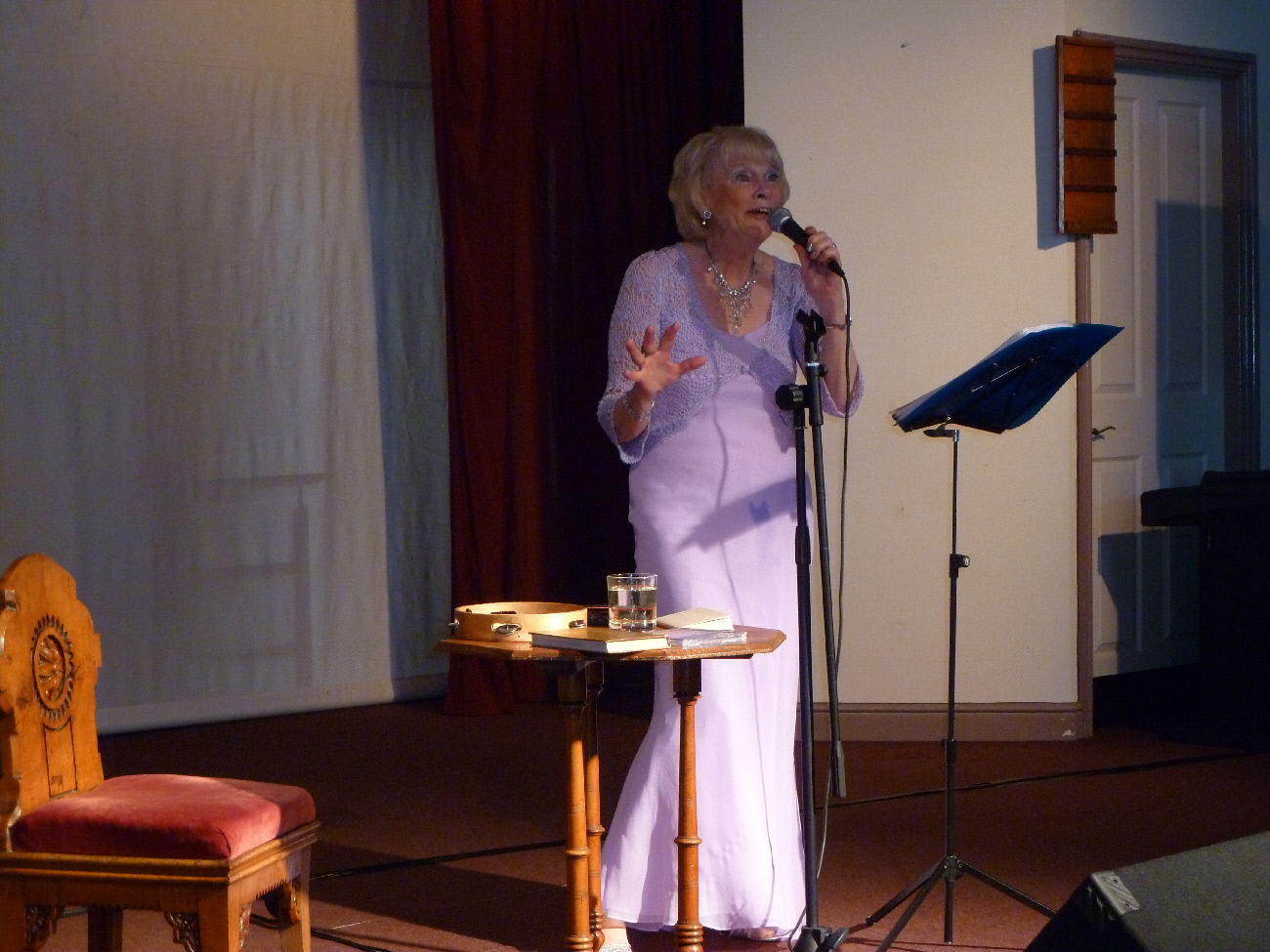
Val Wiseman in concert
The witty and moving lyrics were written by Val herself. On Sunday night, as is the tradition, we provided our own entertainment at a dinner in the Old White Lion, attempting to write limericks on Brontë themes and enjoying a sketch called Fawlty Parsonage written by the Brontë Society Membership Officer and performed by Museum staff.
Museum staff perform the comedy sketch Fawlty Parsonage
Monday and Tuesday we had excursions to two interesting historical houses, the Elizabethan Levens Hall near Kendal in the Lake District and Oakwell Hall in Birstall. 

Levens Hall in Cumbria
The Brontë link with Levens Hall is somewhat tenuous (not that we minded this!); the 1999 BBC series of Brontë biographer Elizabeth Gaskell’s Wives and Daughters was filmed there. We also visited the farmhouse in Silverdale, Morecambe Bay, where the novelist spent summer holidays.
Oakwell Hall in Yorkshire, the model for Fieldhead in Charlotte Brontë’s novel Shirley
Oakwell Hall has a less tenuous link with the Brontës; Charlotte visited it when staying with her friend Ellen Nussey and used it in her novel Shirley as Fieldhead, the home of the novel’s heroine. We were given a brilliant guided tour enlivened by ghost stories and the sight of groups of schoolchildren, demure in period costume with white caps, being instructed in crafts of the period by ladies in shawls and aprons.
The next Brontë Society AGM weekend is on 14-15 June 2014. The full programme of events always begins on Friday and ends on Tuesday. We hope many more Brussels Group members will join us in Haworth next year.
Helen MacEwan
  
Marina Saegerman writes:
One of the most pleasant surprises of the weekend for me was Val Wiseman’s performance on Saturday evening. I knew Val had a beautiful voice and I had heard some of her songs on CD, but the way she brought the Brontë story through her songs and her comments was just amazing.
There was a wonderful feeling of intimacy with the audience and so much respect for the Brontë family. I thoroughly enjoyed the evening and could have stayed a bit longer to listen to Val’s interpretation of the Brontë’s lives and work. Very good entertainment.
On the other hand, “The Brontë boy” was a bit of a disappointment to me. Having read so many good reviews, I expected so much of it. The respect I found in Val’s performance was lost to me in this one. I could hardly recognize father Patrick, Charlotte, Anne and certainly not Emily (my goodness!!). And Branwell was all too gloomy all the time, it seemed as if he really was doing everything against his will. The only character I liked was John Brown. On the whole, I had mixed feelings about this play. I would certainly not recommend it further.

But throughout the weekend I really enjoyed the walks and the talks, and the wining and dining, and the excursions. It is a pity that the Brontë Society has decided to move the AGM to a date a week later, and that therefore I might most probably not be able to attend!

Monday, 17 June 2013

The BS excursion to Brussels; a 20th Anniversary

This year sees the 20th Anniversary of the first Excursion made by members from the Brontë Society.
A few of our current BBG members were there to witness that week in April 1993.
Eric Ruijssenaars and Maureen Peeck have given their personal accounts.


"The Excursion"

It was twenty years ago last month that the memorable Brontë Society Excursion took place. Not only was it, on hindsight, an important step towards the creation of the Brussels Brontë Group, it also quite changed my life. In a way the Excursion feels like it happened fairly recently, but in reality it has entered the realms of history, with research needed to recall those magical five days.I remember the excitement started months before, when Selina, our friend Elle and I decided to join. Elle, as readers of Helen’s book will recall, had made me a Villette fan and researcher. I had written for her a history of the Isabella quarter. It became the first chapter of my first book, which might not have existed without that Excursion. And my career certainly would have been different without the book.The ‘photographic memories’ I have are only a few. Selina dressed as Jane Eyre is unforgettable to all. Apart from her, the other scene that comes to mind is us three and three British ladies, in the Park, near the Kiosk, probably. One of them was Dyddgu Pritchard-Owens, from north Wales. She’s still a dear friend. I thought we first met on the Tuesday, but she, when I asked her about it on the phone, immediately said it was at the graves of M. and Mme. Heger at Boitsfort, on the Wednesday.  

Pearl Cragg was one of the other two ladies. In the dark days, when Villette and Brussels were all but forgotten, she and Elle were the only Villette fans left. Pearl made pretty much annual pilgrimage journeys to Brussels. She knew all most of what was known, which wasn’t much however. Without Pearl the Society might still not have organised an Excursion to Brussels. The greatest compliment I later got for my books were given by her. They were her constant bedside books, she once told me. Pearl was also there at the 2003 Excursion. That was her last visit to Brussels. The rise of the BBG must have pleased her greatly.

She died in 2011. Dyddgu remembers that Pearl laid one rose on M. Heger’s grave.

I remember M. Fierens giving a fascinating talk. An eternal regret is that I did not make notes. I also remember a few scenes at the Place Rogier hotel where the Society members were staying, and waving goodbye to them when they left from there on the Friday. There is also the memory of Charlotte Cory and me sitting at a bar, somewhere, on the Wednesday I think. She was quite impressed by the pile of research papers I showed her, and encouraged me to apply for the Brontë Society Centenary scholarship. Charlotte does deserve much credit for organising the Excursion to Brussels, for the first time in, indeed, the Society’s 100 years of existence.

Slowly some memories come back. Maureen Peeck, a dear friend ever since too, I first met at about the arrival of the coach from England with the Society members. At the Place Rogier. That cannot have been before about 3 pm. The British members must have been horribly exhausted. The coach had left from Haworth at 2 am, according to the the programme booklet. “Approximate arrival at Ostende: 3 pm.”The Tuesday we spent in and around the Isabella quarter. 


On Wednesday we visited Boitsfort and Waterloo, and in the evening there was the great party at the residence of the British ambassador. A great party indeed, yet I only have the scenic memory of the photograph I have, and nice flowering plants behind where the photographer stood. On Thursday we went to the Park Theatre, but I remember nothing of that. 


In the evening Charlotte Cory presented her (second) novel at Waterstone’s, of which I have some memories. But not of the last meal togethether at the Grand Place afterwards. But after Dyddgu told me, I do now remember too a last, quite lenghty meeting in the hotel lounge.I will always remember it vividly as a wonderful week, one of the very best in my life. 


Eric Ruijssenaars


Account of the 1993 Brontë Society Excursion

Recently I spent a pleasant day in Leiden with Eric Ruijssenaars. Naturally we were reminiscing about our Brontë experiences and suddenly realised that we had known one another for twenty years. We met 20 years ago in Brussels at the April 1993 Brontë Society Excursion. I had never been to Brussels before and, though I had been a life-member of the Brontë Society since 1974, I had never then been to any Brontë events. This was because they were always held at awkward times of the year for me. Of course I had been to Haworth at Christmas and in the summer as we had a holiday cottage in Oxenhope. 

I was quite surprised at the large number of members on the excursion and how nice they were to me, a new-comer. There was such a feeling of camaraderie. I soon met up with Eric R and Selina Busch as they were the Dutch contingent and I also live in the Netherlands, (though English). They took me on a little tour of Brontë sites. They were already researching the area and had been studying the archives at the city registers. They took me down the narrow rue Villa Hermosa which comes to a dead end at a side wall of Le Palais des Beaux Arts. Originally of course this had led down to the rue d'Isabelle where the Pensionnat was situated.  

Another highlight was our visit to the British Embassy on the anniversary of Charlotte Brontë's birthday. We were all supposed to dress in Victorian costume and indeed many people had actually entered into the spirit of the thing (see photo on p 13, Brontë Society Gazette, issue 9, July 1993) and really looked the part. 

We had a very enjoyable afternoon with tea on the lawn. 

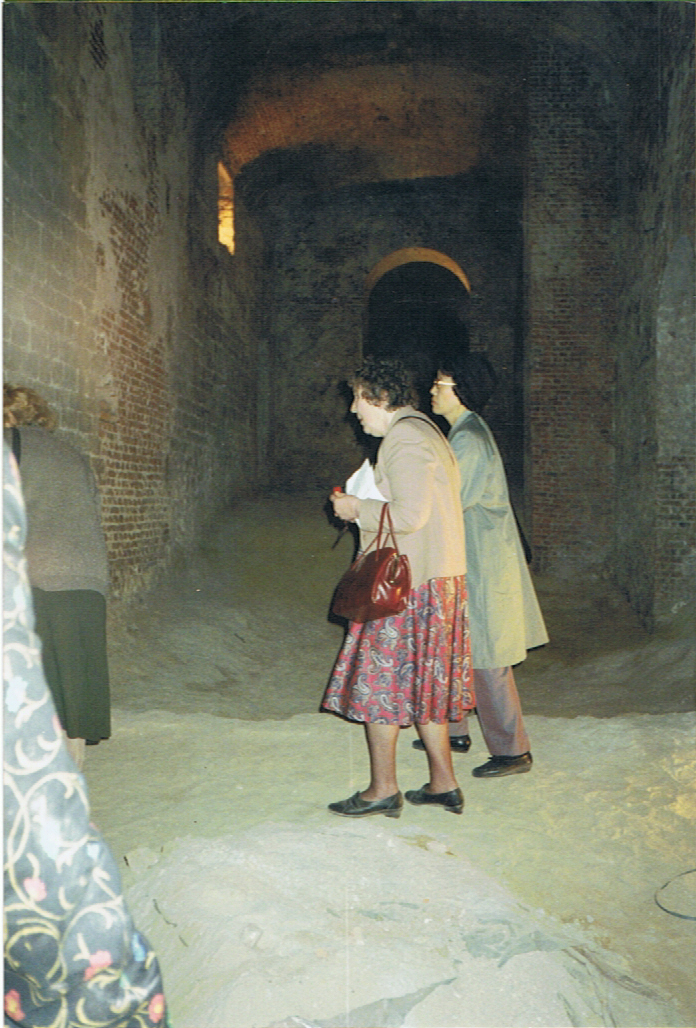
Then on another day there was the underground exploration led by the city architect. They had just started excavating the ancient palace of Charles V which lies under the present Place Royale. So we had to slither down a steep and long sandy slope and be led through the darkness ending up amazingly in the original rue d'Isabelle which we followed until it ended in another wall of the Palais des Beaux Arts. 

This was the part of the street which the Brontë sisters could not have known. So while their part of the street has been demolished the more ancient one remains.

Finally, I well remember that M. Fierens, a descendent of  M and Mme Heger, gave us a very stimulating talk about his family. And of course our visit to Waterloo.

Maureen Peeck

The excursion was later reported in the BS Gazette by Charlotte Cory, who had helped to organize it.


Tuesday, 14 May 2013

Brussels learns about a new Bronte novel and sculpture - in ‘gothic’ surroundings

On 7 May members of the Brussels Brontë Group were guests at the launch of a novel about the Brontë sisters’ time in Belgium. ‘De Meester’ (‘The Master’), a new novel by Dutch author Jolien Janzing, charts Charlotte’s arrival in Brussels with her sister Emily, and her subsequent relationship – professional or otherwise - with school master Constantin Heger. 
The event was held in Brussels’ magnificent 15th century town hall. The city authorities opened up the hall’s Gothic chamber and adjoining reception area for speeches and celebratory drinks.

Jolien’s exciting book is for now only available in Dutch, but readings at the launch event included sections translated into English. Jolien was able to take the audience through events ranging from the well-documented - the Brontës’ life in Haworth and arrival in Ostend – to unfamiliar new scenes. Intriguing new passages included characters discussing King Leopold’s infidelities, and hints that Charlotte’s confession at the Cathedral of Saint Michael and Saint Gudule may have been prompted by more than just loneliness.

Jolien Janzing reads passages from her novel 'The Master'
The author also read an imaginary letter from Charlotte to her ‘master’, while Lex Jansen, her publisher, read a speculative reply from Monsieur – which, if real, would have given the eldest Brontë sister good reason to believe herself his “favourite pupil.”

Jolien Janzing’s foreign rights agent Laetitia Powell told the audience that translators from several countries have expressed interest in the new novel, opening up the possibility that the book will become available to read in other languages. Powell added that at this year’s Berlin International Film Festival (Berlinale) ‘The Master’ was selected from hundreds of applicants to be put on a shortlist of contenders to be made into a film. Powell promised to keep fans up to date with progress towards a translation or a film.

To round off the spring evening’s cultural events, sculptor Tom Frantzen presented more good news for Brontë lovers in Brussels. The Flemish artist showed his audience a wonderful small model of a windswept Emily and Charlotte. If the project is approved and funding is found, this will be installed as a life-size statue close to the Belliard steps the sisters descended 170 years ago. Frantzen’s many other works include animals at the Africa Museum, and a figure emerging from a manhole in Molenbeek to trip up a police officer – as well as the well-known Madame Chapeau and Het Zinneke in the city centre.

Joliens signs her book

Emily Waterfield

To see a trailer for Jolien's book, please click on the following link: http://www.bronteinbrussels.com/themaster/themaster.html

Tuesday, 30 April 2013

Report on 7th Annual Brussels Weekend 19-21 April 2013

Brussels member Selina Busch reports on the talks given by Elizabeth Merry and David Grylls at our 7th annual Brontë weekend in Brussels.

On Saturday, we welcomed two speakers from the UK.

Elizabeth Merry is a lecturer for NADFAS (National Association of Decorative & Fine Arts Societies) in the UK and abroad on literature, art and architecture. Elizabeth gave this presentation to BRIDFAS (Brussels Decorative and Fine Arts Society) last year. Not many of our members were able to attend that talk, so we invited her this Saturday to present it to our group.
David Grylls directs (or rather directed, as the day before this talk, he retired!) the literature programme at the Department for Continuing Education at Oxford University. He has written books on Charles Dickens, George Gissing and Victorian parent-child relationships. His current project is a book on the treatment of sex in Victorian fiction.

In her lecture, The Young Brontës and Art, Elizabeth opened up a visual world for us. With the familiar Brontë biographical context running through the story, Elizabeth highlighted the ways in which the young Brontë children developed their sense, understanding and execution of art as part of their imaginary world.


As they were growing up, almost every item in the house containing images were a course of inspiration to their impressionable minds. Until the middle of the 19th century, children’s books hardly existed, at least not in the form we know today. Literature for children mainly existed in the form of moralistic, religious stories, meant to improve the morals of children.  The sources of inspiration to Branwell, Charlotte, Emily and Anne were Blackwood’s Magazine with tales of explorers, copies (engravings) of paintings and reproductions of John Martin’s paintings of apocalyptic scenes from the Testament hanging on the walls of the Parsonage and many pictures in books, including the influential work Bewick’s History of British Birds. Everything was grist to their mill. 

An important moment in their young lives, which sparked a whole creative outpouring, was the toy soldiers Branwell received from Patrick for his 9th birthday which started off a whole imaginary world: the History of the Young Men.  Their imagination led them to create their own kingdoms, Angria and Gondal, giving them limitless unchartered, exotic territories to create, as Chief Genii. They invented their own thrilling stories filled with powerful characters, which were all written down in minute little books and were given form in drawings, maps and sketches. 
Their real-life hero Byron, whose works they read (their reading wasn’t censored) would become an obsession. The Byronic hero would be a great influence throughout their creative lives. 

All the children were self-taught; they learned about art through copying. Their minds worked like sponges; they absorbed everything in great detail. Given that none of them had ever seen an original work of art, their eye for detail in their faithful copies is remarkable. Sometimes, they would embellish an image they had seen to suit their own needs for their particular characters or imaginary cities. 
Branwell, from an early age, was considered a real artistic promise in the household. Like all the children, he doodled on empty pages (endpapers) in books and his early doodles show real talent. He lived and breathed his fantasy countries, drawing battle scenes, detailed maps and creating Byronic heroes such as Alexander Percy (Northangerland). Branwell had a fascination for the darker side of life and for rakish heroes, as his subjects show, both in writing and art. He named his toy soldier Napoleon.

 When Branwell grew up, he was given lessons in oil-painting by a professional artist, William Robinson, a pupil of the great portrait painter Lawrence.  An early oil painting is the familiar ‘Pillar’ portrait of the Brontë teenagers, which he painted when he was 17. It was previously believed he later painted himself out of the painting because of his self-loathing later in his troubled life, but it is now considered that it was in fact because he wasn’t satisfied with the composition. Branwell went on to study portrait painting, but he later gave up any idea of a career in professional portrait painting. 

Charlotte also showed great talent and even she, at one time, considered becoming a professional artist. But the minute handwriting and obsessive detailed copying she did as a child ruined her eyesight for the rest of her life. And oil-painting wasn’t considered to be a woman’s profession. As so-called ‘copying’ manuals came into the Brontë household, she avidly copied the great masters; her observation of mouths, noses &c, show the determination to improve her skills. These studies resulted in fine drawings after engravings of e.g. a Madonna and child by Raphael.  Her watercolours of landscapes and plants are also highly executed.  In contrast with Branwell, with whom she collaborated on Angria, hers is a fascination for the romantic side in her stories, which is clearly visible in her portraits of Zamorna and refined, beautiful ladies.

Where Branwell and Charlotte in their Angrian world would use the lure of the exotic, daring and romantic and copied mainly sources from illustrations in books and magazines, Emily would look to nature as a source for her art. The countryside and climate featured in her Gondal work were directly based on her beloved Moors. She didn’t like copying other people’s works and looked to her immediate surroundings as a source of inspiration. Very few drawings of hers remain, but her exquisite drawings of the household pets speak of her love for nature and animals, which she preferred to people. 


Elizabeth finished her talk with Anne. She was the only one of the three sisters who actually liked children and we were shown an image of a pretty little girl with golden hair.
At the end we saw one of Anne’s most intriguing drawings: Sunrise at Sea, a compelling picture telling a hopeful message.  Elizabeth commented that it had similarities with a well-known work of art by the German painter Caspar David Friedrich ‘Wanderer above the sea of fog’. She argued that the Brontë children, though they chiefly saw engravings of English and classical painters, might possibly have been aware of the visual art of the continental Romantic movement. 


With Elizabeth’s beautifully illustrated presentation, we witnessed a spellbinding and illuminating lecture.

      After lunch, the lecture room in the University St. Louis was centre stage for a completely different subject.
Dr David Grylls took the rostrum to talk about Sex in Victorian Fiction, which is the title of the book he has recently finished.  This would prove to be an entertaining and very interesting topic which had attracted quite a crowd of listeners.  Dr Grylls, the perfect speaker, had both the knowledge and wit to entertain us for nearly two hours, and brought many interesting facts to our attention not covered in previous talks!


The lively mood was set when he mentioned a series of modern-day spiced up novels with titles such as Pride and Promiscuity, Sense and Sensuality. And he told us how people often react in two ways when he mentions the title of his new book: 1) There ISN’T any sex in Victorian literature or 2) Ah yes, the Victorians were a dirty lot!

How did Victorian novelists talk about sex without talking about it? And where did this constraint come from? One factor was the increasing sensibilities of the strong Evangelical movement of that period. Another major factor was the mechanisms of Victorian publishing, where it was decided what was acceptable or not. Novels, real bound books, were really expensive in the Victorian period and if you wanted to read the latest novels, the circulating libraries, or in magazines, were the only places where you could obtain them. These libraries, for example Mudie’s, had a strict code on what was acceptable.  For instance, when Jude the Obscure came out, it caused uproar (it was nicknamed Jude the Obscene) and was withdrawn from the circulating libraries, after which sales collapsed. Any hint of a sexual nature, and the novel was taken from the shelves.

Because of this censorship, which started to change slightly as the 19th century progressed, you’ll often find various versions in different editions. In the case of Hardy, he re-wrote sentences and passages in different editions.  Dr Grylls gave examples of this change in attitude.

There were ways in which novelists got round the tricky set of rules. Victorians novels are full of courtship and romance, and authors devised numerous strategies for hinting at sexual desire or implying the existence of feelings that could not be openly stated. The novels are filled with both carefully and cleverly constructed narratives and symbols which would be understood by the Victorians themselves.


For instance, there are ways of describing pregnancy: ‘in the family way, in an interesting condition, delicate, an extra room needed to be found in the house!’ In Dickens’ David Copperfield, the reference to Dora’s stillborn child is not always understood by modern readers. Sometimes, in Wuthering Heights for example, we suddenly discover that a female character is pregnant, yet no mention is made of it anywhere in the text before. In Gaskell’s Ruth, we see a 2-month gap between Ruth’s seduction and her being pregnant (but apparently unaware of it).

Another example is how writers would describe scenes relating to prostitutes, brothels or rape.  E.g. never in Oliver Twist does Dickens ever mention that Nancy is in fact a prostitute. Nothing is ever said openly, no actual words used, but readers of that time were expected to deduct the meaning of what was written. This of course differed depending on whether you were a mature male reader (familiar with the ways of the world), or a young innocent girl, protected and guarded from all the vices.

Today however, the modern reader can misconstrue words and sentences, as language and its ‘meaning has changed.  ‘Making love’ in the Victorian sense means something altogether different to today’s understanding of the term. This change of perception can have hilarious consequences, and Dr. Grylls had plenty of examples up his sleeve to make us laugh.

In particular, the significance of suggestive symbols, objects and images were discussed in the second part of Dr. Gryll’s talk. To name but a few examples: music, colours, archery, flowers, jewelry, hair, and smoking. All these descriptions of small details would have been meaningful for Victorian readers. In music, the suggestion of a couple was hinted by the sweet combining of voices in mutual song, e.g. Frank and Jane in Jane Austen’s Emma. Colours depicted moods and virtues: red for love and sensuality, white for chastity or purity. Describing a female archer would often show off her figure. In Jane Eyre we find a reference to jewelry, as Rochester wishes to adorn Jane with jewels, which symbolise sexual possession. Jane refuses to be ‘bought’.

A important symbol is that of hair, in particular female hair. Lovers give each other locks of hair as personal keepsakes, a man secretly steals clippings from a woman’s hair, women’s long tresses are combed, rich woman wear hair pieces in order to be more desirable.  But there is also another sexual significance of female hair: when it is loose and flowing it often symbolises sexual abandonment or even madness. Bertha Mason in Jane Eyre stands for both these.


One last symbol Dr Grylls explained to us was smoking, in particular cigars, associated with masculinity and symbolising the gratification of male desire. Seducers often smoke cigars -Eugene Wraybourn in Our Mutual Friend, George Osborne in Vanity Fair when he lights his cigar with one of Amelia’s letters. And what about the scene where M. Paul blows cigar smoke in the writing desk of Lucy Snow? Or the one where Jane tries to slip away from the garden as she detects Mr. Rochester cigar smoke.


Dr Grylls could have continued to entertain us for some time, but alas, time was up, and our day of excellent talks from these very good speakers was was at an end. How lucky we were that they were willing to join us in Brussels.


Selina Busch

Sunday, 7 April 2013

'The Brilliant Brontë Sisters'. ITV Brontë documentary on Sunday 31 March 2013


I was pleased to be in England over the Easter break and able to watch this documentary, one of ITV's Perspectives series. As a Brontë enthusiast I didn't expect a one-hour programme to tell me anything I didn't already know, but was interested in seeing how well the story was presented; for some viewers it would be their introduction to the family. But I also had two particular reasons for watching with interest. A novelty of this documentary was its recognition of the importance of Brussels for Charlotte Brontë, and last October the programme’s presenter, Sheila Hancock, and the film crew had spent an afternoon with members of our group exploring Charlotte and Emily's time in the city. My second reason was more personal. I knew that Sheila Hancock had also been filmed in the British Library looking at Charlotte's letters to M. Heger, and a couple of days before the broadcast I had at last carried out my long-standing intention of viewing the letters myself in the Library's manuscript room (see below).

The programme starts with the amazingly spry eighty-year-old presenter cavorting on a common in the south London suburb where she grew up. Bexleyheath, rather than the Yorkshire moors, was where she imagined herself as a girl to be Cathy after falling in love with Heathcliff – or rather with Heathcliff as she had seen him in the local cinema, portrayed by Laurence Olivier. That was before she came to realise that he was in fact 'a vicious psychopath'. The question she sets out to answer is: 'How did three spinsters who spent most of their life in a remote parsonage write books I find shocking, erotic and quite wonderful?'


Her quest for answers does not just take her to the Parsonage in Haworth, where she chats with the Museum curator about the Brontës' juvenile manuscripts while sitting in the tiny bedroom where the fantasy worlds of Gondal and Angria were created. She also goes to Roe Head School where the girls went as pupils and, in Charlotte's case, as a teacher; to the National Portrait Gallery and the British Library in London; and, of course, to Brussels.

On the Eurostar bound for Brussels she speaks of the sisters' plan to start a school of their own and their wish to improve their teaching qualifications by brushing up their foreign languages on the continent. Having just spent a chilly week that October filming on the Haworth moors, Sheila braved the cold of a freezing day in Brussels at the end of the month as she joined a group of our members on a guided walk led by Myriam Campinaire. Of the three hours of filming, less than three minutes made it off the cutting-room floor, but we all enjoyed being involved in the project and we're all smiling despite the weather. The programme makers felt there wasn't time to say much about Villette, which many viewers wouldn't have read. Instead, in Grand'Place after the walk, Sheila muses on how Charlotte's time in Belgium fed into the better-known Jane Eyre, and compares Jane's feelings on leaving Rochester with Charlotte's on leaving Brussels and Heger.

The programme more or less falls into three parts, the first focusing on Emily and Wuthering Heights, the second on Charlotte and Jane Eyre and the third on Anne and The Tenant of Wildfell Hall, her novel about marriage with an alcoholic, with Branwell being brought into the story as the example of alcoholism Anne had before her as she wrote. Sheila also talks to creative artists whose works have been inspired by the Brontës – dance choreographer David Nixon, playwright Polly Teale and artist Paula Rego. There was a danger that all this would be too much to pack into a short documentary, but by the end all the essential components of the Brontë story have been neatly fitted in.

The Brontës have obviously accompanied Sheila Hancock all her life, from her youthful passion for Wuthering Heights to her empathy much later in life, after losing her husband John Thaw ('Inspector Morse'), with Heathcliff’s sufferings when Cathy dies. Her genuine enthusiasm and emotion make this programme the moving tribute the Brontë story deserves.

A private viewing of the Brontë-Heger letters

On Thursday 27 March, at the start of one of the coldest Easter breaks I've ever experienced, I turned out of the busy Euston Road, past Paolozzi’s statue of a giant Newton crouching over his compasses and onto the piazza of the red-brick British Library. 


A few people were shivering over coffees on a cafe terrace this freezing morning.
I was eager to go inside the building, and not just to get out of the cold. I had an appointment to do something I'd wanted to for years – look at Charlotte Brontë's four extant letters to Constantin Heger.
The inside of the building is striking, with several levels of galleries running round an atrium whose centre, from floor to skylight, is occupied by a kind of massive glass-fronted bookcase packed with old leather-bound books.

Although I had not found the British Library website very user-friendly when pre-registering for a pass and requesting access to the letters, procedures in the building were relatively hassle-free. A rather stern man issued me with a reader's pass, taking a photo of me for this purpose every bit as unflattering as the one on my Brussels Royal Library card. In the manuscript room I had to present a letter of introduction before the first of Charlotte’s letters to M. Heger was drawn out of the wooden case in which they are kept and placed on a heavy leather-lined tray for me to peruse. Each is written on two sheets of notepaper which have been framed in glass so that you can read both sides of the sheets. Unlike another Brussels Brontë enthusiast who consulted the letters some years ago, I wasn't required to wear white gloves!

I knew that Sheila Hancock, when she was filmed looking at the letters as part of the Perspectives Brontë documentary, believed she had made a discovery when the camera zoomed in on a full stop, at the end of a paragraph, in the shape of a heart! I peered at the stop in question but, sadly, have to report that in my opinion any resemblance to a heart is coincidental!


I had taken along the text of the letters but Charlotte's handwriting is so neat they were hardly necessary. Despite the tears in the paper where the letters were ripped up by Heger and the white stitches where they were sewn together again by his wife, it is quite easy to make out Charlotte's anguished words. I had found these moving before seeing them in the original. It goes without saying that it is even more moving to read them in manuscript as they left her pen, on the sheets she sent to Heger and that he tore up, and that have survived so miraculously to be read by us today.

The four letters, dated 24 July 1844, 24 October 1844, 8 January 1845 and 18 November 1845, are in Smith, Margaret, ed., The Letters of Charlotte Brontë, Volume I, 1829-1847, Clarendon Press, Oxford, 1995.


Helen MacEwan